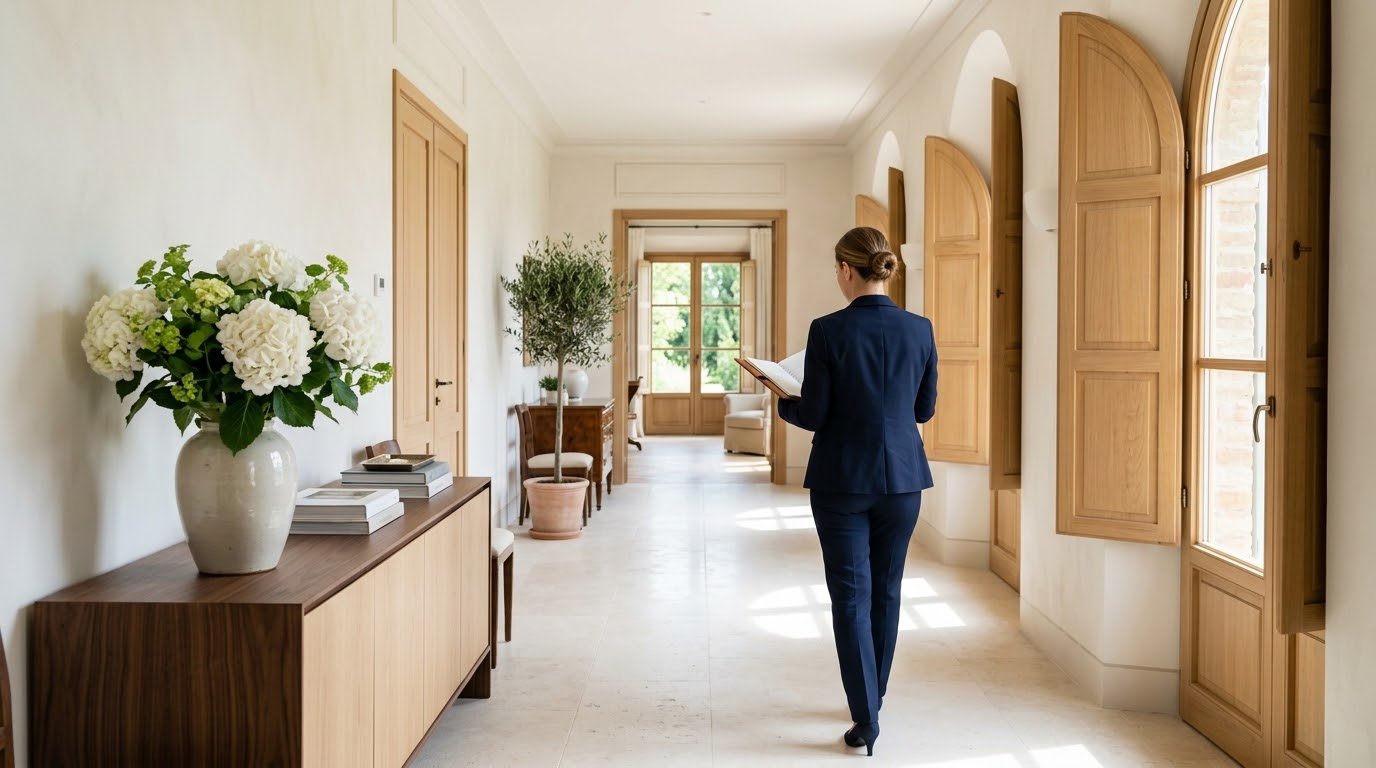
A house manager’s job is hard to explain at a dinner party. Say “I run a house” and people hear either something grand or something slightly dodgy. The truth is worse for conversation: you spent the afternoon counting napkins and arguing with a boiler.
Families put the question better. What does a house manager actually do, and do we need one? A list of house manager duties would run to several pages and still miss the point. The clearest answer we know is a day. Here is a typical one, put together from summers in the houses we have kept, with the details shuffled so that no house could be recognised. July, the family in residence, guests for dinner.
A day in July, hour by hour
06:30 The first round
The day starts with a walk through the house, alone, before anyone is up. It is the only hour when you see the place as the family will see it. Kitchen first: fridge temperatures, the early deliveries, whether last night’s glasses came out of the dishwasher. Then the alarm log, the note left by whoever locked up, a look at the pool. In July the shutters on the south side stay closed until evening. The family likes the light. The furniture and the paintings do not, and someone has to take the furniture’s side.
Small things are put right now, quietly: a bulb that went, a towel forgotten on a terrace chair, hydrangeas that gave up in the night. Anything bigger goes in the notebook.
07:15 Ten minutes in the kitchen
Everyone on duty meets in the kitchen: housekeeper, chef, butler, driver, and on some mornings the head gardener. Who is home today. Who arrives, who leaves. Lunch. Which car is wanted, and at what time. Ten minutes, standing up. If it takes longer, something was not decided yesterday.
08:00 Breakfast, watched rather than served
The butler or the housekeeper serves. The house manager watches from the edge of the room. Is the coffee the way they take it? Is the paper there? Has the youngest’s cereal been replaced with the one he actually eats? None of this lives in anyone’s memory. It lives in the House Book, because memories take holidays.
09:00 The office hour, which is never an hour
Emails, invoices, the budget. The florist’s quote approved, the window cleaners chased, the piano tuner confirmed for Thursday, the laundry paid, a question from the family office about last month’s spending. Staff ask about rotas, days off, a uniform that does not fit. Nobody photographs this part of the job, and it is most of the job.
10:30 Deliveries and the grounds
The fish, the flowers and the wine arrive, and each is checked against the order. On Martha’s Vineyard we learned to treat the ferry timetable as a household document: when the boats stop for the wind, so does half the shopping. Then a walk round the grounds with the estate manager, or with the head gardener if there is no estate manager. This week’s business: the hedges cut before the guests come, not during; the irrigation timer, which has opinions of its own; the lavender, which the gardener would like to cut now and the family would like to look at until August.
12:30 The plan changes
Over lunch, dinner for twelve becomes dinner for sixteen. Nobody should see an eyebrow move. Behind the kitchen door it means another leaf in the table, four more places of silver counted and polished, the menu stretched without losing its shape, two spare bedrooms made up in case anyone stays, and a message to the driver: the last guests now leave at midnight, not eleven.
14:30 The quiet hours
Staff lunch, then rest, by rota. In Italy the national contract gives live-in staff whose day runs from morning into evening an unpaid break of at least two hours, normally in the afternoon, and a good house manager defends it even on a day like this one. Tired people drop glasses. Meanwhile the guest rooms get their inspection with the housekeeper: beds, flowers, water by the bed, reading lamps that work, and the particular pillows for the guest who asked for them last year. Guests remember who forgot their pillows.
16:00 The house itself
An engineer comes about the pool pump, which has started to make a noise. Someone has to meet him, take him to the plant room, follow what he says and decide whether it can wait until September. Then the architect rings about the winter works on the boathouse. None of it is glamorous. All of it decides whether the house still works in five years’ time.
18:00 Arrivals
Two house guests land at six. The driver messages from the airport. The housekeeper unpacks for them if that is how this family does things; it is in the House Book, and it varies more than you would think. The house manager is at the door, or has made sure the right person is.
19:30 Before the guests
Last round. The terrace lights go on and the candles get lit. Citronella burns somewhere nobody can see it, and the music comes down to a level the neighbours can live with. Then one more word with the chef: the timings, and the guest who will not touch shellfish. The butler runs the table; the house manager makes sure the table has everything it needs to be run.
20:30 Dinner
During dinner a house manager is mostly invisible and slightly busy. Watching the kitchen’s pace, sending a second pair of hands to clear when the first is held up, warning the driver, making sure the late shift has eaten. If the family notices the house manager at all during dinner, something has gone wrong.
23:30 The last round
Doors, windows, alarm. One lamp left on in the hall for a guest driving in late from Milan. Notes for tomorrow’s briefing: the broken glass to replace, the pump, an earlier breakfast for the guest catching a flight.
No single person should work all of that, and in Italy the contract would not allow it: ten hours a day for live-in staff, with eleven consecutive hours of rest. A day like this is split. We work as a couple, which helps. One of us takes the early round, the other the last.
House manager, butler, estate manager, housekeeper: who does what
Titles travel badly. The housekeeper of an old English country house ran half the staff. In a London flat today, she might come in three mornings a week. Ask for a governante in Italy and you may get a head housekeeper, or someone who runs the whole place. So describe the work. Do not rely on the title.
| Role | Looks after | Answers for |
|---|---|---|
| House manager | The house as a whole: staff and rotas, suppliers, budgets, standards, the family’s calendar at home | Everything inside the front door |
| Butler | Service: the table, wine, guests, silver, valeting | How the family and their guests are looked after when they are at home |
| Estate manager | Grounds, buildings, systems, security and projects, often across several properties | Everything outside the front door and behind the walls |
| Housekeeper | Rooms, laundry, linen and fabrics, wardrobes, cleaning routines | The state of every room, every day |
What separates a butler from a house manager is mostly how far the job reaches. The butler’s job is people. The house manager’s job is the machinery that keeps those people looked after. In a smaller house the two jobs often become one, and a good head housekeeper can run the place single-handed. Merging roles is fine. Merging them without saying so is how a house ends up with three people who each believe someone else is in charge of the boiler.
A house manager is sometimes called a household manager, especially in London and the United States. Same job, longer business card. Pay differs between these roles more than families expect; we have set out current ranges in what household staff earn in Italy and Switzerland.
What families get wrong when hiring a house manager
- Hiring a hotel. A hotel general manager has departments, a night manager and an engineering team. A house manager at eleven at night has a torch. Hotel experience is useful, but it is a different job.
- One person, four jobs. We have read house manager job descriptions that also wanted a cook, a driver, a nanny and a bookkeeper. That is not a job description. It is a staff list.
- All of the blame, none of the authority. If the house manager cannot tell the staff what to do, or sign off an invoice, you are paying a great deal for a messenger. Settle what they can sign and the ceiling on it. Then tell the team.
- Five bosses. Two parents, a grown-up son, a family office and a PA, all giving instructions to the same person. Everyone can keep their opinions, but there should be one line of reporting.
- Hiring in May for June. Good house managers are rarely free at a week’s notice, and the ones who are tend to be free for a reason.
- No trial day, or a trial day nobody watched. A day in the house, with the family there for part of it, tells you more than three interviews.
- No handover. Otherwise the newcomer learns the house from the person who is leaving, who is not always in a generous mood.
Signs you need one
- Your weekends go on the house. The plumber, the invoices, cover for the gardener’s holiday.
- Staff keep leaving, and every one of them got a different set of instructions from a different relative.
- Every year it is the same leak in the same corner, because fixing it properly is nobody’s job.
- No one can say when the silver was last counted. Or who has the spare cellar key.
- Guests arrive and their room is nearly ready.
- There is a second house, and that is the one that always lets you down.
- More people work in the house than the family can brief over breakfast.
How to brief a house manager
A good house manager will learn your house whatever you do. A good brief means they learn it in weeks rather than seasons.
- Who decides. Name the one person they answer to, and what they may decide alone: hiring, spending, which contractor to call at night.
- The year. When you are in residence, when guests come, which dates are fixed, when the house opens and closes. Closing a summer house properly is a job in itself.
- The standards. How beds are made and the table is laid, the coffee, the temperature of the rooms, the flowers, what “ready” means on arrival. If you do not write your standard down, you will get somebody else’s, usually their last employer’s.
- The money. The budget, the accounts, how invoices are approved and who pays what.
- Privacy. What may be said to whom, photographs, social media, guests’ names. The confidentiality agreement is signed before the first day, not after the first slip.
- The people. Who is on the team, what they do well, what has gone wrong before. Be honest; they will find out by Thursday.
- Time. Ask for a few weeks of observation before any change. A house manager who reorganises the linen cupboard in the first week is either very good or about to be very unpopular.
All of this belongs in one document. We call it the House Book. Every house we keep has one, and we have turned its structure into a House Book kit for families and house managers who want to write their own. If you would rather write it with us, that is what our household consulting is for: two days in the house, an honest diagnosis, then the book.
When the house needs a new person, our staff search starts from that brief, before anyone opens a CV. And if you would simply like someone to run the house, that is household management, led by one of us in person. Either way, tell us about the house.