
Marble keeps a diary, and it’s a terrible gossip. The morning after a party it’ll show you, in faint pale rings, exactly who put a glass of white down without a coaster, and the dull little ghost by the basin has the precise outline of somebody’s perfume bottle. That trail of matte freckles on the kitchen island? Lemon, nine times out of ten. When people ask us how to clean marble, the awkward truth is that much of what’s bothering them isn’t dirt, and you could scrub until Easter without shifting it. So here’s how we look after it in the houses we keep, and most of it comes down to knowing what you’re actually looking at.
Why marble marks so easily
Under the polish, marble is calcite, plain calcium carbonate, which makes it a cousin of chalk and limestone that’s had a few million years of heat and pressure to smarten up. Acid eats it. And rather quickly: leave a splash of wine or orange juice sitting for twenty minutes and you may well find the shine gone underneath, while vinegar hardly needs that long. The American government’s historic-buildings people, who have more marble to worry about than most of us, keep a list of the usual offenders: wine, beer, fruit juice, vinegar, tomato, mustard, fizzy drinks, ink and salad dressing. Which is, give or take the ink, a whole dinner party.
Etch or stain? Learn to tell them apart
If you remember one thing from this piece, make it this. Call it an etch when acid has nibbled the shine clean off. Usually paler than its neighbours, it goes all flat and chalky once you crouch and squint at it against the window, and with your eyes shut a fingertip will sometimes find a faint rasp. No cleaner on earth will fix it, for the simple reason that nothing’s been put there. Something’s been removed.
A stain works the other way round. Something has crept into the stone and stayed: olive oil from the bottom of a salad bowl, coffee, a red wine nobody spotted till morning, rust off the base of a planter, ink from a soggy newspaper. It’s usually darker than its surroundings, and quite often it can be coaxed back out again. Get the diagnosis wrong and you end up attacking a dull etch with something gritty until it’s twice the size, which we’ve seen more than once and it never stops being painful to watch.
How to clean marble every day
Here’s the surprise for most families: spills do less harm to a marble floor than sand. Grit on the soles of shoes behaves like very fine sandpaper, and in one busy summer it’ll grind a dull path from the front door to the fridge. So our floors get swept dry most days, soft broom or microfibre, long before anyone goes near a bucket, and there’s a proper doormat by each garden door, since that’s where the sand comes trooping in from.
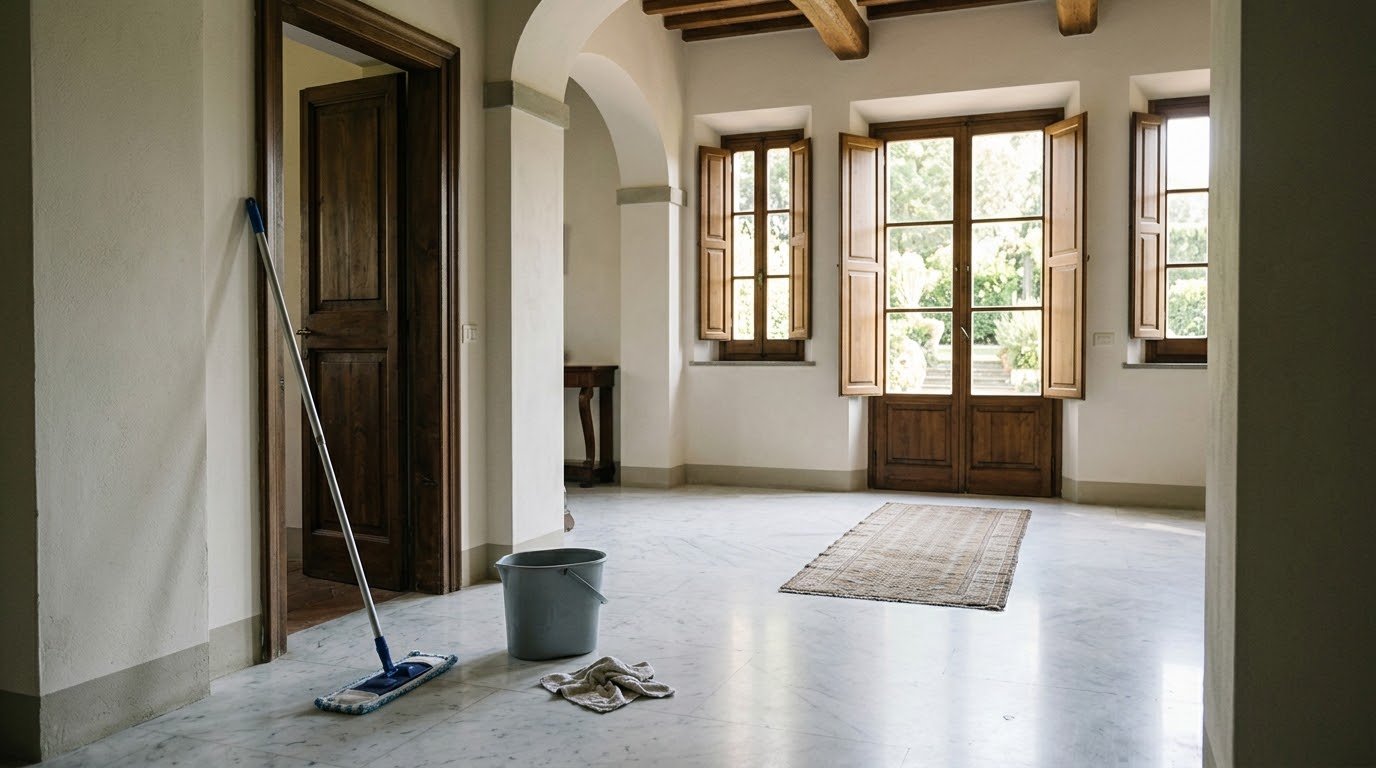
On washing days it’s warm water with a pH-neutral cleaner, or one sold for natural stone, and a soft mop. Then comes the rinse in clean water, swapped whenever it greys, which everybody skips before blaming the streaks on the bottle. We towel polished floors and worktops dry with cotton afterwards.
We keep a list taped inside the cleaning cupboard of things that must never touch the marble, and it’s longer than you’d guess. Vinegar and lemon, plus all those cheerful “natural” sprays that turn out to be made of them. Limescale removers, along with most bathroom cleaners, which are acidic on purpose. Kitchen sprays with bleach in. Cream cleansers, scouring powder, wire wool, wire brushes, and those little white melamine sponges that seem to clean everything (they’re abrasive, which is the secret of their success). Unsure about a bottle? Dab it on some corner that lives behind a door, then leave it a few days, because stone can take its time to sulk.
Kitchens and bathrooms, the usual crime scenes
A marble worktop survives on habits more than products. A board under anything acidic before the knife comes out. The oil and vinegar bottles parked on a small tray. Coasters every time, yes, even in August when they feel a touch precious. And whoever’s nearest wipes the spill the moment it happens, rather than leaving it for the person whose job it officially is.
Bathrooms are trickier still, since half of what lives on a vanity is acid in a pretty bottle: scent, toner, certain soaps, plus the limescale spray a well-meaning person brought from home. Every bottle on our marble stands on a tray, and somebody squeegees the shower walls after each use, which stops limescale getting a foothold and means nobody’s tempted to reach for anything acidic to get rid of it later.
Getting a stain out with a poultice
Think of a poultice as a face mask for the floor: as the paste dries it sucks the stain back up and out. The version we use comes from a preservation procedure. You stir a white powder (plaster, flour, chalk, talc, fuller’s earth or whiting, whichever’s to hand) into the active ingredient till it’s about as thick as royal icing, then slap it on a few millimetres deep, overlapping the stain, tape cling film down round the edges and forget about it for two days. Coffee, tea and wine, the organic lot, we treat with hydrogen peroxide, same as that procedure. Then you wet the crust a little, prise it up with a wooden or plastic spatula (never metal, it scratches), rinse, and go again if the stain’s only paled.
On white Carrara, a peroxide poultice is generally the first thing a restorer tries. Coloured marble is touchier; peroxide is perfectly capable of bleaching the stone along with the stain, so experiment somewhere nobody looks. With an antique floor, or anything you’d mind losing, ring a stone restorer instead. A botched poultice leaves a ghostly pale ring that’s a worse job than the original mark ever was.
Dull patches, etches and what sealer really does
Little shallow etches on a polished counter often come good with marble polishing powder, rubbed gently and only ever the way the tin tells you. Deep ones, or a floor that’s clouded over along every route people take to the kitchen, are work for a stone restorer (a proper marmista, here in Italy), who’ll hone the surface and polish it up again. It isn’t cheap. On a beautiful floor, though, it’s far better value every few years than a great deal of anxious scrubbing in between.
Sealer is useful, just not in the way people hope. A decent impregnating sealer slows liquids down on their way into the stone, which buys you a few precious minutes to mop up the Barolo before it becomes permanent. It won’t save you from etching, not even slightly, since acid attacks the face of the stone and not its pores. Once or twice a year we drip some water on the worktops and floors and watch; stone that darkens inside a few minutes is telling you the sealer’s worn through and wants another coat.
A routine for marble in a working house
In practice: floors dusted dry and worktops wiped after meals, every day, plus the squeegee after showers. Weekly, a proper wash with neutral cleaner and a rinse. Twice a year we do the water test, walk the whole house with a notebook noting new etches and stains, and decide what can wait. And every few years the restorer comes, ideally before the paths through the hall get dull enough for guests to notice. How all that fits around everything else is in a cleaning schedule for a large house, and if the house shuts for winter, the stone has its own lines in closing a summer house properly.
Marble’s rather like silver in that respect, a surface where doing less usually means doing better, and you’ll find the same thinking in our guide to cleaning silver.
If you’d like your team to work from written procedures rather than habit, The Household SOP Library has forty ready to adapt, a blank form and a short guide to writing your own. And if the floors, terraces and stonework of the house need someone to look after them properly through the year, that’s our estate management. Either way, tell us about the house.
Questions
Can you clean marble with vinegar?
No. Vinegar is an acid and marble is calcium carbonate, so vinegar dissolves the polish and leaves dull etch marks. Use warm water with a pH-neutral cleaner or one made for natural stone.
What is the difference between an etch and a stain on marble?
An etch is a dull patch where acid has removed the polish; it is usually lighter and looks matte in raking light. A stain is a substance absorbed into the stone, usually darker. Stains can often be drawn out with a poultice; etches need re-polishing.
How do you get a stain out of marble?
With a poultice: an absorbent white powder mixed with an active agent (hydrogen peroxide for organic stains such as coffee or wine) into a thick paste, spread over the stain, covered with plastic and left for about two days before lifting it off and rinsing. Test on coloured marble first.
Does sealing marble stop etching?
No. An impregnating sealer slows how fast liquids soak in, which helps against stains, but acids attack the surface itself, so sealed marble still etches.
We write the Journal from our own work in private houses in Italy and Switzerland. Every house has its own rules: take what fits yours, and ask us about the rest.