
A big house can’t be cleaned top to bottom every week, and the sooner everyone accepts that, the cleaner it gets. Twenty rooms, three staircases, a guest wing nobody’s slept in since August and a boot room that seems to manufacture mud: try to give all of it the same attention every Monday and by Thursday the team is exhausted and the drawing room is dusty anyway. The fix isn’t a longer list. A good cleaning schedule for a large house is a rhythm people can carry around in their heads (some of it daily, some weekly, a lot of it in rotation and a little only once a year), which takes most of the panic out of Mondays.
Why a big house needs a rotation, not just a rota
The people who clean the biggest houses in Britain worked this out a long time ago. In National Trust houses, the floors on the visitor route are vacuumed before opening, the dark polished tables near the route get dusted whenever they show it, and the more delicate things further away (chair backs, table legs) are brushed with soft brushes two or three rooms at a time, in rotation, week by week. Then, once a year, every room is cleaned thoroughly from ceiling to floor, contents included. Some fragile pieces are on even longer cycles, with tapestries every five to ten years and paintings every twenty-five.
Two of their observations are worth pinning above the sink. Most surface dust, they say, comes off people’s clothes, which explains why the sitting room you use every evening is grubbier than the ballroom nobody has danced in for years. And dust that’s left to sit eventually glues itself on, at which point getting it off means more rubbing, more water, more risk. That, really, is the whole case for a schedule: two heroic scrubs a year are harder on the house, and on the people doing them, than a bit of steady, boring attention every week.
Every day: the reset
The daily round is smaller than people expect. It covers only the rooms somebody actually lived in yesterday, and its job is to put them back as they were at breakfast rather than to clean them, so the bed gets made, the bathroom is wiped and dried, and the kitchen goes back to a state you’d be glad to walk into at seven in the morning. A good housekeeper does it as a sort of loop, gathering newspapers and plumping cushions on the way through. The one thing that really can’t wait for the weekly round is the hall and kitchen floor, because that’s where the grit marches in from the garden, and grit on stone is sandpaper. Bathrooms and the kitchen get their windows opened or their fans run while they’re steamy, which sounds like nothing and is in fact the cheapest mould prevention there is; the US Environmental Protection Agency suggests keeping indoor humidity below 60%, ideally between 30 and 50.
What the daily round shouldn’t become is a full clean of every room, every day. That’s how the team runs out of hours before the weekly jobs ever get started.
Every week: the full round, plus a few rooms in turn
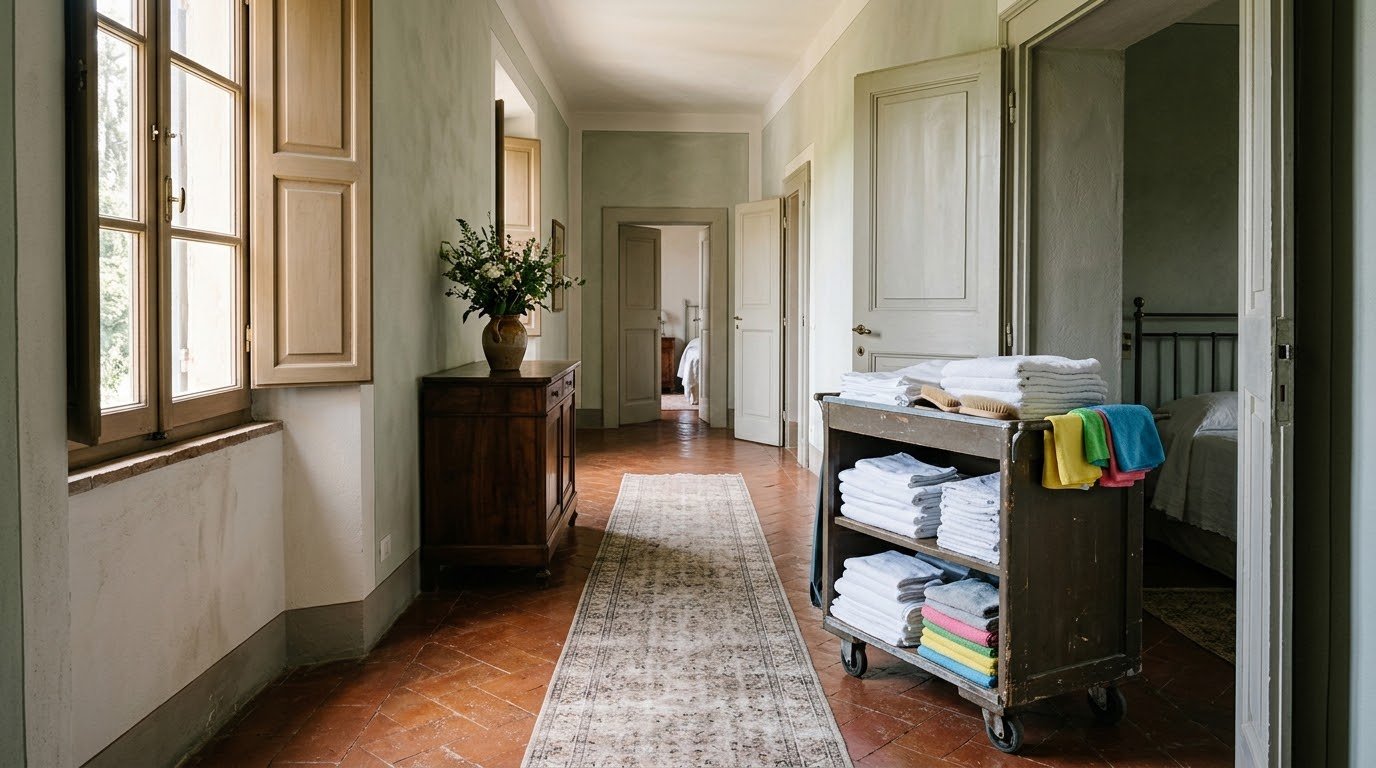
The weekly round is where the real cleaning happens in the rooms being used. We dust from the top down, for the obvious reason, and we’re fussy about the vacuum going under the sofas and right along the carpet edges, since the strip by the skirting is precisely where moths like to set up home and it’s the bit a hurried vacuum always skips. Bathrooms get scrubbed properly, beds are stripped, the glass and mirrors are done, and somebody casts a critical eye over the fridge and the larder. Stone floors get their wash with a neutral cleaner and a rinse, the way we describe in how to clean marble, and any silver in daily use is washed, dried and given a quick rub before it goes back in the drawer.
And then, borrowing the National Trust’s trick, two or three of the rooms nobody’s using get a turn: the guest bedrooms, the library, the formal dining room between dinners. Over a month every room in the house is visited properly at least once, and nothing quietly sits for a season gathering the sort of dust that welds itself on. When a guest room’s turn comes round, it’s also the moment to check it’s ready for someone to arrive at short notice, which is the whole subject of preparing a guest room.
Every month: the places that hide
Monthly jobs are the ones you’d never notice skipping until you notice all at once. The insides of kitchen cupboards and drawers, skirting boards, door frames (and the tops of them, which nobody ever looks at), light switches, lampshades, picture frames, the inside of the windows. Extractor filters. Mattresses turned or rotated if the maker says so. Wardrobes opened, hanging wool shaken out and moth traps looked at, for reasons set out at some length in getting rid of clothes moths. Anything that came back from the laundry with a stain gets dealt with now rather than left for spring.
Every season, and once a year
The seasonal jobs follow the house’s own calendar more than the weather’s. Curtains brushed or sent away, rugs turned and cleaned underneath, outside windows, gutters and the terraces, the chimneys swept every year or two, the boiler serviced before the cold sets in. The silver gets its proper polish before the dinners of December rather than in a panic on the morning of one, with the gentler methods in how to clean silver. Linen gets counted, mended and rotated in January, when nothing much else is happening.
Once a year, every room gets the National Trust treatment, ceiling to floor, one room at a time over a few weeks, never the whole house in one go. In a seasonal house that deep clean usually belongs to the closing, when the rooms are empty anyway; the order we follow is in closing a summer house properly.
Who does what, written down
A schedule only exists if it has names next to it. Each job needs an owner, a day and somewhere to tick it off, and the whole thing has to fit inside the hours people are actually contracted for, which in Italy and Switzerland have legal limits; a schedule that only works with unpaid overtime is just a slower way of losing good staff. We keep the schedule inside the house’s manual, next to the routines it comes from, as described in a house manual for household staff, and the jobs that need doing one particular way get a written procedure of their own.
The schedule on one page
| How often | What | Note |
|---|---|---|
| Daily | Beds, bathrooms in use, kitchen, hall and kitchen floors, cushions, flowers | A reset of the rooms in use, not a full clean |
| Weekly | Dust high to low, vacuum under furniture and carpet edges, bathrooms, linen, glass, stone floors, silver in use | Plus two or three unused rooms in rotation |
| Monthly | Inside cupboards, skirting, switches, lampshades, frames, inside windows, filters, wardrobes and moth traps | The places nobody sees |
| Seasonal | Curtains, rugs, outside windows, gutters, terraces, boiler, silver before December, linen in January | Follows the house’s calendar |
| Yearly | Every room ceiling to floor, one at a time; chimneys every year or two | In a seasonal house, at the closing |
The Household SOP Library has forty written procedures for exactly these jobs, from turning down a bed to the seasonal work, each with its frequency and the standard to aim for. If you’d like the year planned on paper, The House Planner 2027 sets out the work of each month with a page for every week, and The Care of Fine Things comes with an editable care schedule for the silver, crystal, linen and stone. If you’d rather somebody else ran the whole rhythm, that’s our household management. Either way, tell us about the house.
Questions
How do you make a cleaning schedule for a large house?
Split the work by frequency: a daily reset of the rooms in use, a weekly full clean of those rooms plus two or three unused rooms in rotation, monthly jobs for the places that hide, seasonal work and a yearly ceiling-to-floor clean of every room. Give each job an owner, a day and a place to tick it off.
How often should unused rooms be cleaned?
In rotation, so that every room is cleaned properly at least once a month. Dust left for long periods binds to surfaces and becomes harder to remove, and unused rooms are where moths settle.
What is the difference between daily cleaning and deep cleaning?
The daily round resets the rooms the family uses: beds, bathrooms, kitchen, floors where grit comes in. A deep clean goes ceiling to floor, contents included, one room at a time, and in most houses happens once a year.
We write the Journal from our own work in private houses in Italy and Switzerland. Every house has its own rules: take what fits yours, and ask us about the rest.