
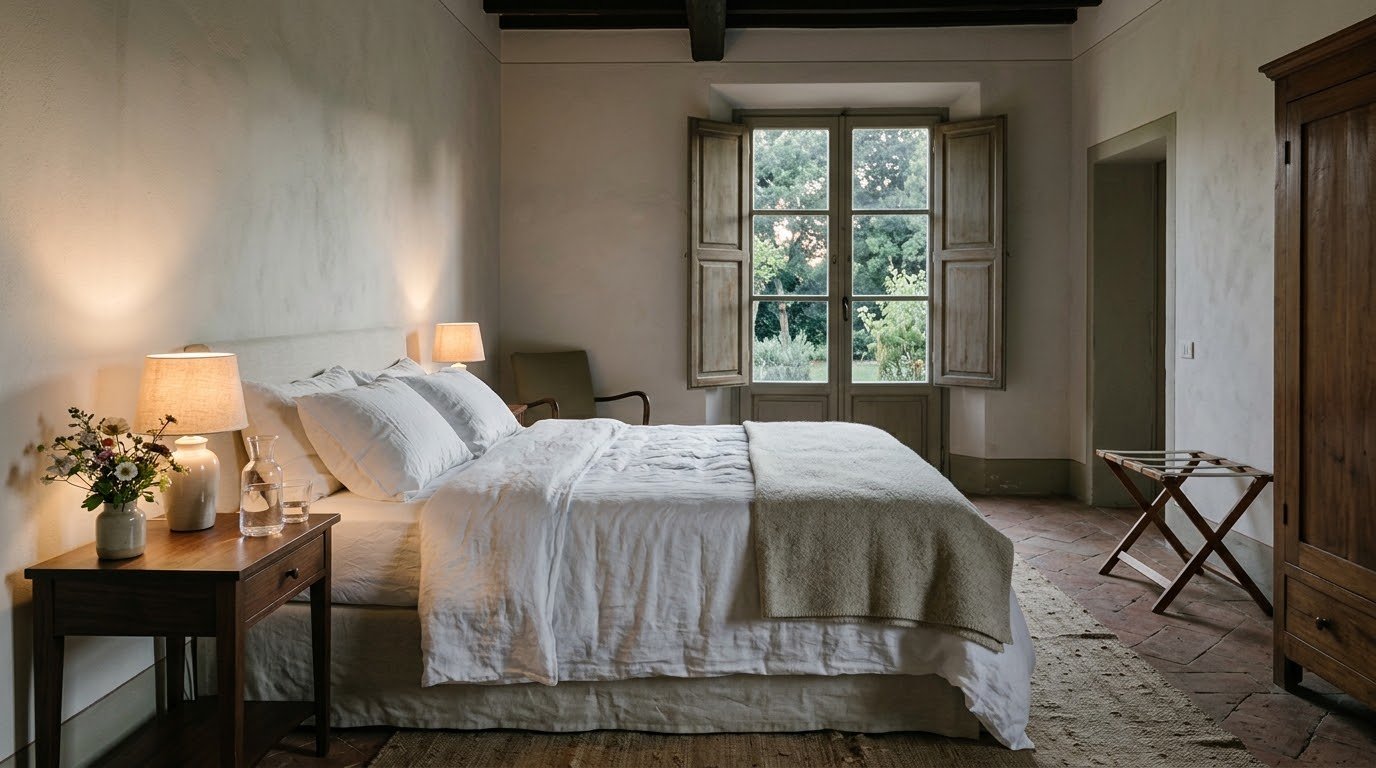
Every guest room looks perfect from the doorway. It’s at two in the morning that it gives itself away: the reading lamp that only reaches one side of the bed, the radiator that clanks into life at five, the curtains that let in a stripe of streetlight right across the pillow, the only socket hidden behind the wardrobe. The best test we know for how to prepare a guest room is to sleep in it yourself, one night, before anyone else does. Everything below is, more or less, the list of things that night tends to teach you.
Start with a few questions
A good guest room is mostly built before the guest arrives, out of a short conversation. When are they arriving, and how (because a nine o’clock arrival after a long drive wants a tray and a quiet bed, not a tour of the garden)? How long are they staying? Do they sleep better warm or cool, with feather pillows or without? Is there anything they can’t eat? Allergies and anything medical go on a separate sheet that only the people who need it see, rather than into a note left lying on the hall table. For guests who arrive with an office and an itinerary, the questions get longer and more formal, and we’ve written them out in receiving a VIP guest at home.
The bed comes first
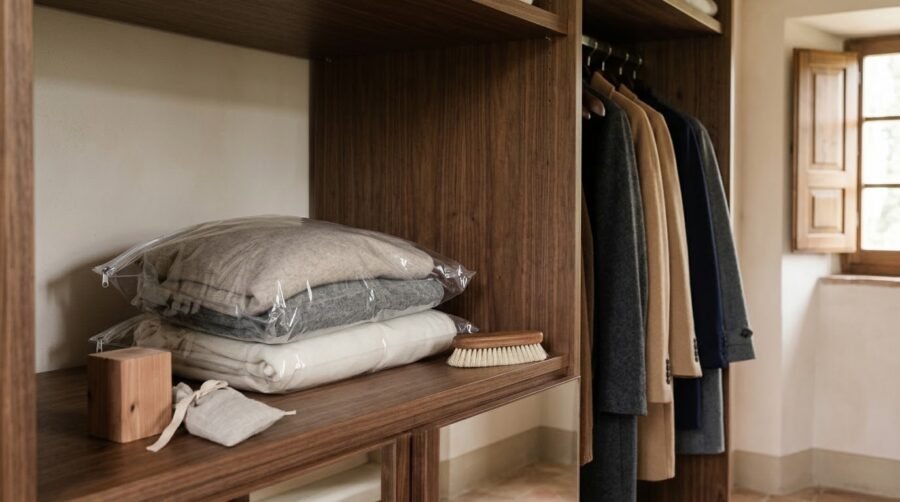
Nobody remembers the flowers in a guest room. They remember whether they slept. So the mattress gets checked properly (turned if it’s the turning kind, with a clean protector on top), the linen is freshly laundered and pressed, and there are two kinds of pillow on the bed or in the cupboard, firm and soft, plus a pair without feathers for anyone who can’t sleep on them. A spare blanket lives at the foot of the bed or in the wardrobe, and if it’s wool and has been folded there since last summer, shake it out and look it over first; empty rooms are exactly where moths settle in, as we explain in getting rid of clothes moths. The bed itself is made the way the house always makes beds, tight corners and all, and turned down in the evening if that’s the custom.
Temperature, darkness and quiet
Guest rooms are nearly always too hot, mainly because nobody has touched the radiator since the last visit. The Sleep Foundation reckons most doctors would have a bedroom at 65 to 68°F (call it 18 to 20°C), so we start there. We also show the guest the thermostat, or the remote for the air conditioning, on the first evening. Leave them to guess and they’ll end up sleeping with the window open in January (it happens more than you’d think). A lighter duvet and a spare blanket wait in the wardrobe, so nobody has to come and ask at midnight.
Then there’s the dark. Shutters where the house has them; where it doesn’t, blackout lining, or failing that a heavy curtain that properly closes in the middle. That bright little gap at six in the morning? Guests notice it. Next comes a test we swear by: switch everything off, sit on the bed for five minutes and just listen. It’s funny what you hear. A dripping tap. A clock. The fridge next door humming away, and the boiler clearing its throat somewhere under the floor. Most of it takes an afternoon to fix or move, and you’d never find out otherwise, because a polite guest won’t say a word at breakfast.
The practical things nobody packs
Empty drawers, real ones, not drawers full of the family’s spare jumpers. Hanging space with decent wooden hangers, including a couple for skirts and trousers. A luggage rack, so a suitcase doesn’t end up open on the bed. A mirror with good light near it. Lamps both sides of the bed. And a socket you can reach without getting out of it, since every guest on earth now travels with a phone that has to charge overnight.
International guests need one more thing. Italy uses plugs of types C, F and L, Switzerland types J and C, both at 230 volts and 50 hertz, so a visitor from London or New York will arrive with plugs that don’t fit. A little basket of adapters in the drawer of the bedside table costs very little and saves a lot of borrowing; for anything from the United States, it’s worth checking the charger says it accepts 100–240 V before it goes anywhere near the socket. And put the guest network’s name and password on a small card, which is one of the few passwords that should ever be written down in a house.
The bathroom
Two sizes of towel per person, plus a bath mat, changed as often as the guest likes and not less than the house would change its own. A dressing gown and slippers on the back of the door. Full-size soap and shampoo (decanted into nice bottles if you like, but please not the tiny hotel ones), a spare toothbrush and toothpaste for whoever forgets theirs, and somebody always does, a hairdryer that actually dries, tissues and a glass. If the shower has a mind of its own (and in older Italian houses it often does), a few words of explanation save a cold start to somebody’s morning.
If the bathroom hasn’t been used for a while, run the shower and every tap for a few minutes in the days before the guest arrives. It clears out stale water, and the UK’s Health and Safety Executive advises flushing infrequently used outlets, showerheads and taps included, at least weekly as part of keeping water systems free of legionella; in a big house with a guest wing, that’s a job for the weekly round, written into the cleaning schedule.
The small welcome
A carafe of fresh water and a glass by the bed. A few books chosen with this person in mind rather than whatever was left over. Flowers, but not heavily scented ones, which can be hard work in a closed room overnight. A card with the rhythm of the house: when breakfast is, who to ask for anything, which rooms are theirs to use. How to get in and out, the gate and the alarm if they’ll be back late, is better explained in person than written on that card.
Then, an hour before the arrival, somebody walks the room one last time. Are the lamps on, the shutters where they ought to be, the room at the right temperature? Water in the carafe, wardrobe floor clear, towels in place? Good. In houses with staff, this is a routine with a written standard, kept with everything else in the house manual, so the room is ready the same way whoever happens to be on duty.
If your guests are official ones, The Protocol Book covers the whole visit, from the questions for the guest’s office to the room, the arrival and the staff briefing, and our free VIP guest check takes twelve questions to tell you how ready the house is. For the beds themselves, hospital corners, fitted sheets folded flat and the turndown are drawn step by step in Wardrobe, Linen & Valeting. And if you’d rather the guest rooms were simply always ready, that’s part of our household management. Either way, tell us about the house.
Questions
What should a guest room have?
A comfortable, freshly made bed with a choice of pillows and a spare blanket, real darkness, a sensible temperature, empty drawers and hanging space, a luggage rack, lamps and sockets on both sides of the bed, water by the bed, and a bathroom with towels, a dressing gown and toiletries.
What temperature should a guest room be?
The Sleep Foundation says most doctors recommend 65 to 68°F for sleep, roughly 18 to 20°C. Show the guest how the heating or air conditioning works and leave a lighter duvet or an extra blanket.
Do guests from the UK or US need plug adapters in Italy and Switzerland?
Yes. Italy uses plug types C, F and L and Switzerland types J and C, at 230 V and 50 Hz. A basket of adapters in the guest room helps, and devices from the US should be checked for a charger rated 100–240 V.
We write the Journal from our own work in private houses in Italy and Switzerland. Every house has its own rules: take what fits yours, and ask us about the rest.