

Nobody ever spots the moth first. What you spot is a tiny hole right in the front of a cashmere jumper, exactly where it can’t be hidden, or a bald patch in the rug under the bed that everyone swears wasn’t bald last winter. When you do finally see one of the culprits, a small buff-coloured thing that would rather scuttle off into the shadows than fly, its children have generally been dining for months. So when people ask us how to get rid of clothes moths, our answer starts somewhere a little unexpected. Forget the moth you saw. Go and look for the ones you haven’t.
It isn’t the moth that eats your jumper
Grown-up clothes moths don’t eat at all, which comes as a surprise to most people. Their whole job is to find a mate and lay eggs on something woolly, somewhere dark where nobody will bother them. The damage is done by the larvae, creamy little caterpillars no longer than a fingernail is wide, because they can digest keratin, the protein that hair is made of. That puts wool, cashmere, fur, felt, feathers and silk on the menu, plus leather. Cotton and synthetics mostly get left alone, unless they’re blended with wool or carrying food or body oils.
And that last bit matters more than anything else in this piece. English Heritage, who fight moths for a living in some very old houses, point out that stained areas of a textile get attacked before the clean bits right next to them. The jumper you wore once and put back in the drawer because it “wasn’t really dirty” is, to a moth larva, a cooked supper with the table laid. In a normal house one generation takes about a year, but somewhere warm and centrally heated you can get up to three, which is how a small problem in March becomes a wardrobe-wide one by Christmas.
Signs of clothes moths, and where they hide
Holes are the obvious sign, along with threadbare patches and rugs where the pile has quietly gone missing. Look closer and you’ll often find fine silky webbing across the surface of the fabric, or little tubes the larvae spin and live in (one common species actually drags its case around with it, made out of whatever it’s been eating), and frass, which is the polite word for droppings: tiny grains, often the same colour as the wool they came from.
The larvae like it dark and undisturbed, so that’s where to search. Under collars, behind lapels, inside pockets, in trouser turn-ups and along the creases of anything folded. Under rugs and heavy furniture that never moves, along the edges of fitted carpets where the vacuum doesn’t reach, in deep-buttoned upholstery and cushions stuffed with feathers. And further afield, in the places nobody thinks to check: an old bird’s nest in the eaves or the attic, a blocked chimney, wool lagging round a pipe in the loft. A house can be immaculate downstairs and still have a moth nursery two floors up.
One more thing before you declare war. Clothes moths avoid light, so the moth bumbling round your reading lamp at eleven at night is probably something else, very often a pantry moth that has come from a forgotten bag of flour in the kitchen, which is a different problem with a different fix. And carpet beetle larvae leave damage that looks a lot like moth damage, according to the University of Kentucky’s entomologists, so it’s worth having a proper look at the culprit if you can catch one.
How to get rid of clothes moths in a week
Pick a dry day, because everything’s coming out. The whole wardrobe or chest gets emptied, every drawer and every shelf, and as each piece comes out it goes into one of three piles: untouched and clean, worn and needing a wash, or visibly eaten. Anything in the second or third pile goes straight into a sealed plastic bag before it’s carried through the house, so no larvae get a free ride to the next room.
Then the empty furniture gets the most thorough vacuuming of its life, with the crevice tool along every joint, corner and runner, and the carpet edges and the floor underneath along with it. It sounds almost too simple, but English Heritage’s own guidance says regular vacuuming does more to stop moths building up than anything else. Empty the bag or the canister into a sealed bag and take it straight to the outside bin, or you’ve just moved the colony into the cupboard under the stairs.
Freezing, washing and dry cleaning
For anything that can’t be washed hot (cashmere, most knitwear, a felt hat, a fur collar) the freezer is the safest fix we know. Seal the piece in a plastic bag, push out as much air as you can and leave it at −18°C for at least two weeks, which is English Heritage’s figure for killing every stage, eggs included. When it comes out, leave the bag shut for at least a day, so the condensation forms on the outside of the plastic and not on the wool.
Hot washing and dry cleaning kill eggs and larvae too, and so does the heat of a tumble dryer, but “hot” and “cashmere” really shouldn’t appear in the same sentence. The care label wins, every time, and anything you’re unsure of goes to a good dry cleaner. Rugs, upholstery and anything else too big for a freezer are a job for the professionals, who’ll use a commercial freezer or a controlled heat treatment instead.
Traps, lavender, cedar and mothballs: what each one really does
Pheromone traps are little sticky cards scented like a female moth, and they’re brilliant at what they’re for, which is telling you where the moths are coming from and whether things are getting better. What they aren’t is a cure. The lure only works on the males of one species, so the females carry on laying eggs regardless, and a trap full of moths is information rather than victory.
Lavender bags and cedar balls do repel adult moths, a bit, in a closed space, for three months at the most before they need replacing, and they do nothing whatsoever to larvae already in the wool. Cedar wardrobes and chests rarely seal tightly enough to hold a useful concentration of the oil, say the Kentucky entomologists. So by all means keep the lavender for the smell. Just don’t mistake it for a lock on the door. Old-fashioned mothballs we don’t use at all: the smell gets into everything, and many of the old formulations are now banned or not recommended. Insecticide sprays have a small place, along carpet edges and gaps in floorboards, ideally applied by a pest professional; a can sprayed into the air kills a few flying adults and never reaches the larvae, and nobody should be spraying the clothes themselves.
Storing wool and cashmere so they don’t come back
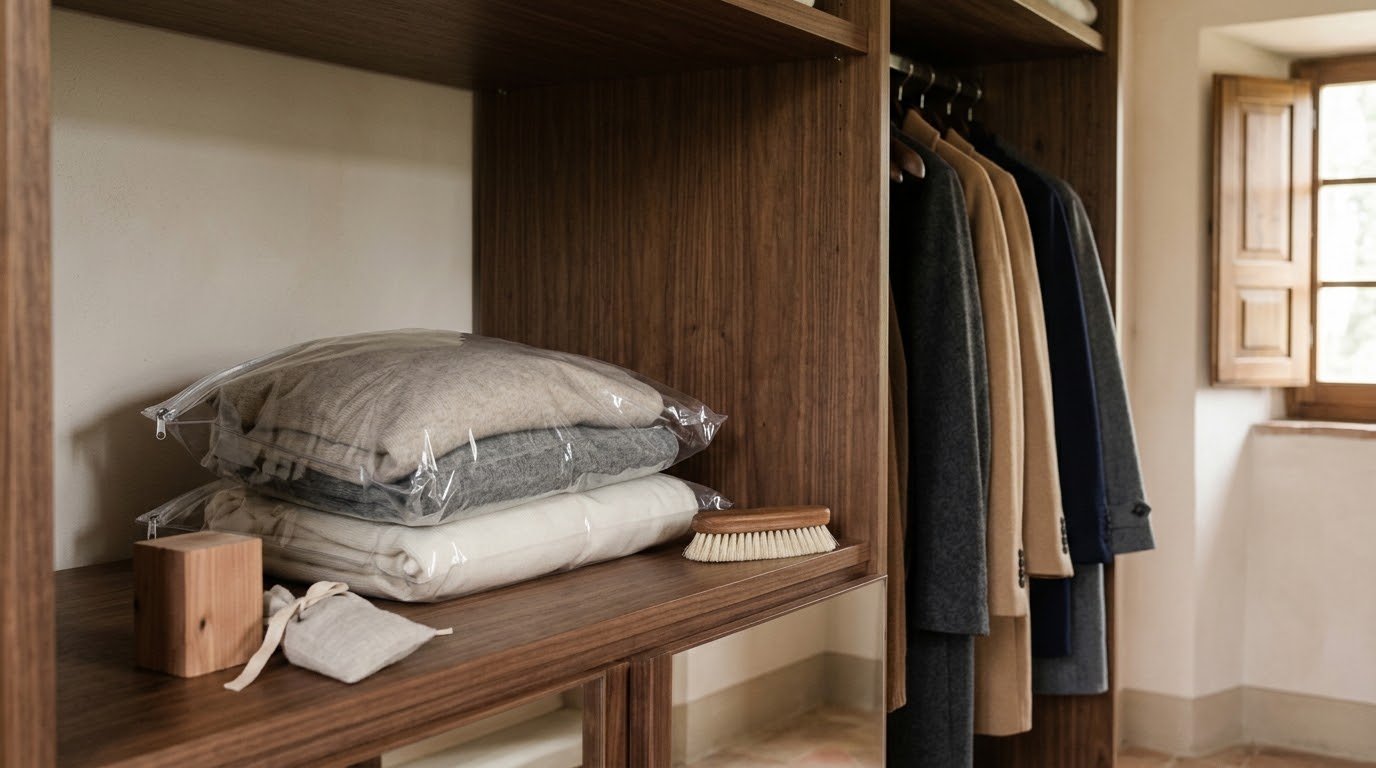
Clean first, always, even if it was worn once, even if it looks fine, because the soiled spot is the one they’ll find. Then into sealed bags (vacuum bags are ideal) or boxes with lids that actually close, which, as far as we can tell, is the single change that saves the most knitwear. Hanging wool coats and suits want a shake or a good brush at least once a month, since moths hate being disturbed and a garment that moves regularly is a much less attractive nursery.
The rooms to worry about are the ones nobody uses: the spare-blanket cupboard, the coat cupboard of a summer house, the wool throw folded at the foot of a guest bed since Easter. If you’re getting a room ready after months empty, our guide to preparing a guest room starts with exactly that check, and when a whole house shuts for the winter, the textiles have their own section in closing a summer house properly.
A moth routine for a working house
None of this works as a one-off. In the houses we keep, the hanging wool gets shaken out and the traps get checked once a month, the wardrobe floors and carpet edges get vacuumed with the crevice tool on the weekly round, and any woollens that will sit unworn all summer get cleaned, bagged and, if there’s any doubt, frozen before the warm weather starts. Once a year someone goes up into the attic to look for birds’ nests, and open chimneys get swept every year or two, both of which English Heritage recommends and both of which are easy to forget. How it all slots into the rest of the housework is in a cleaning schedule for a large house.
Washing each fibre properly, a stain chart, cashmere, silk and moths are all in The Care of Fine Things, and folding and storing a wardrobe so it stays in order has its own illustrated guide, Wardrobe, Linen & Valeting. If you’d rather somebody else kept an eye on the wardrobes, the linen and the attic, that’s part of our household management. Either way, tell us about the house.
Questions
What is the fastest way to get rid of clothes moths?
Empty the wardrobe, bag anything suspect, vacuum every corner and carpet edge, then freeze, wash or dry-clean each affected piece according to its care label. Freezing works at −18°C for at least two weeks in a sealed bag.
Do moth traps get rid of moths?
No. Pheromone traps attract only the males of one species, so they are a tool for finding where moths come from and checking whether things improve. The females keep laying eggs, so the cleaning and treatment still have to be done.
Does lavender keep clothes moths away?
Only a little. Lavender and cedar repel adult moths in a closed space for up to three months and have no effect on larvae already in the fabric. Clean storage in sealed bags or boxes does far more.
Why do moths eat cashmere and not cotton?
Clothes moth larvae digest keratin, the protein in hair, so wool, cashmere, fur, silk and feathers are food. Cotton and synthetics are rarely attacked unless blended with wool or soiled with food or body oils.
We write the Journal from our own work in private houses in Italy and Switzerland. Every house has its own rules: take what fits yours, and ask us about the rest.