
Every house with silver has a drawer somewhere that nobody likes to open. Inside, wrapped in newspaper or nothing at all, there’s a coffee pot gone the colour of a storm cloud and a set of fish knives that last saw a dinner around the time of the euro. Somebody will want them for Christmas. So, how to clean silver without ruining it? Our answer surprises people, because most of it is about polishing less, not more.
Why silver goes black in the first place
Tarnish isn’t dirt. It’s silver sulphide, a thin black skin that forms when the metal meets sulphur compounds in the air, hydrogen sulphide above all. You can’t stop the air doing it, but you can slow it right down. Eggs are full of sulphur, which is why egg spoons go black in a morning (and why old services often have gilded ones). Rubber bands and some felts and wools give off sulphur too; a rubber band forgotten round a set of forks leaves a dark stripe that’s very hard to shift.
What hardly anyone tells you is that polishing takes a little silver away each time, along with the tarnish. A whisker’s worth. Do it every Saturday for a century, though, and the crest on the spoon goes soft and the hallmark starts to blur, which is why the conservators at the Canadian Conservation Institute would rather you prevented tarnish than kept removing it. We’ve come round to their view entirely.
Before you touch it: solid or plate?
We start every job by turning the pieces over. Sterling carries 925; a lot of Italian silver says 800, beside a tiny lozenge with a star in it, the maker’s number and the province’s initials. Plate is a different animal. EPNS and old Sheffield plate are only a skin of silver over another metal, and a heavy hand with the polish goes straight through to a sad pinkish colour that can’t be undone.
Then we look at how each thing was put together, which matters more than people think. Hollow handles on teapots. Candlesticks weighted with pitch inside. Knives whose blades were set into the handle with resin a hundred years ago and will happily come loose in hot water. Gilding, wood, ivory, bone, a stone in a lid. None of that goes near a sink, let alone a dip.
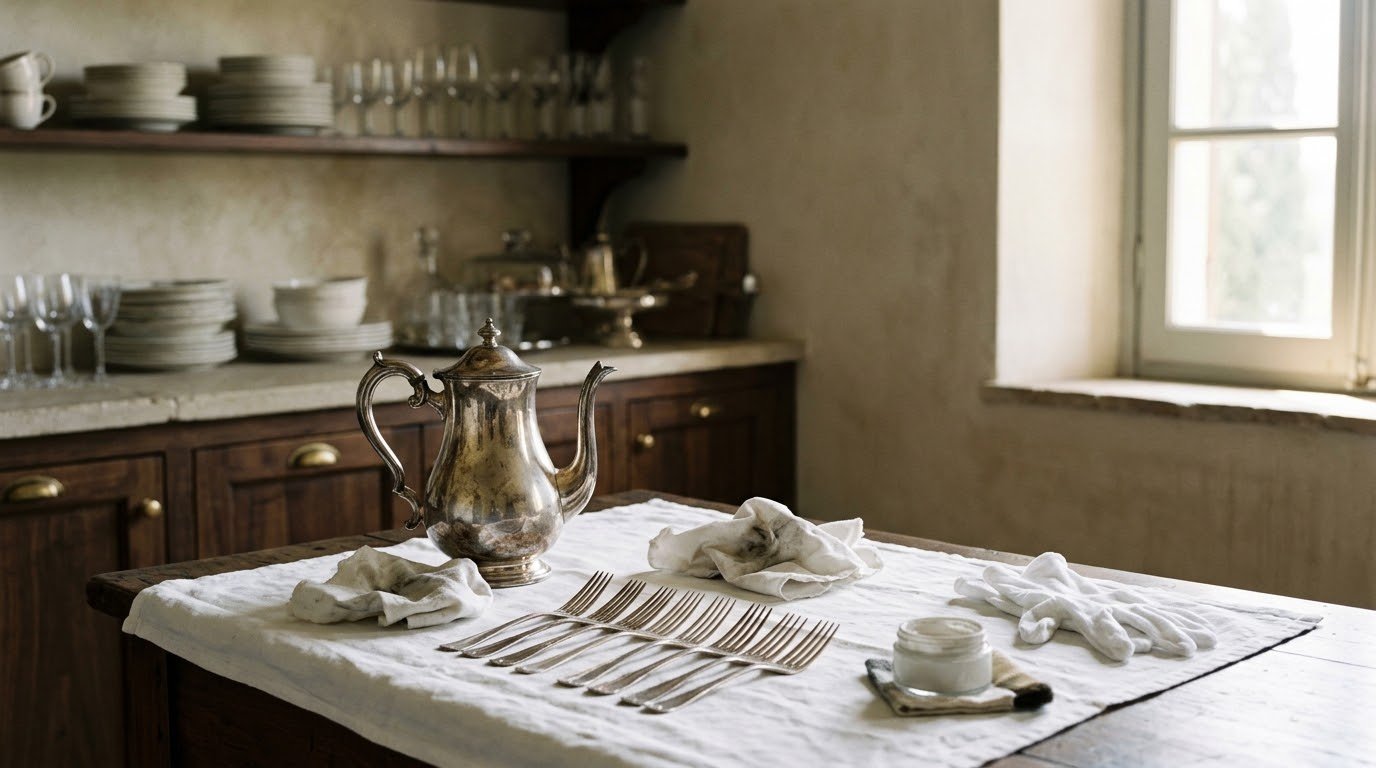
Gloves on, by the way: plain white cotton ones. Skin leaves salt and oil behind, and there’s nothing quite so deflating as finishing a tray beautifully and finding a full set of your own fingerprints on it a week later.
How to clean silver, step by step
Washing comes first
Honestly, half of what gets called tarnish is grime, old dried polish and a little of last year’s gravy. A bath sorts that out. Warm water, a drop of washing-up liquid (the mild, unscented sort), a soft cloth and an old badger shaving brush for the fiddly bits, then a rinse in distilled water if yours comes out of the tap hard, and a soft cotton towel straight after, since drops left to dry on silver leave spots behind. You’d be amazed how often that’s the end of the job.
For light tarnish, a cloth and some patience
The faint yellow bloom you get after a few weeks in a cupboard comes off with a silver polishing cloth, the sort that’s impregnated with a very fine polish. It’s about the gentlest thing there is. We go up and down along the length of a piece rather than round in circles; circles leave little swirls that show up every time someone holds the spoon to the light.
For heavier tarnish, a cream, and not much of it
Properly brown or black silver needs a cream or paste made for silver. Not a general metal polish, which is far too gritty for it. A small dab on cotton wool, one patch at a time, then every trace taken off again. Two things we’ve learnt the hard way. Polish that’s been left open in the pantry since spring thickens and turns gritty, so it goes in the bin. And polish left in the chasing goes green after a while, particularly where there’s copper under the silver, so the brush and a rinse at the end aren’t optional.
The Canadian conservators also publish a recipe they use themselves: precipitated calcium carbonate (precipitated chalk, which a chemist can get you) mixed with distilled water into a paste. It must be the precipitated kind. Ordinary ground chalk and whiting both scratch.
Then dry it, and buff it
Once the residue’s gone and the piece is bone dry, we go over it one last time with a clean, dry cotton cloth. People skip this bit. They shouldn’t; it’s the buff that gives silver that deep, wet look, and without it a piece can be spotless and still look oddly dull.
Baking soda, foil, toothpaste and other tricks
Yes, the aluminium foil trick works. You lay the silver on foil in hot water with soda and the tarnish quietly turns back into silver; it’s a kitchen version of an electrochemical method conservators use, although they use washing soda rather than baking soda. The catch is the finish, which comes out flat and slightly matte, and the way treated pieces seem to tarnish again in no time. We’ve used it on everyday forks when there was no other way. On anything old, hollow, gilded or with a handle that isn’t metal, never.
Dips (the jars you plunge a fork into) are fast and brutal. If there’s really no alternative, we dab the dip onto the dark patch with a cotton bud, rinse thoroughly, and keep it miles away from hollow pieces and anything with wood, bone or stones. As for toothpaste, it’s scouring paste that happens to taste of mint, and it’ll scratch. Lemon and vinegar are acids and belong in the salad dressing.
People always ask about the dishwasher. We don’t put silver in it, ever. The detergents are fierce, and silver that ends up touching stainless steel in the basket can come out with dark spots that only a proper polish will shift. Washing it by hand straight after the meal, before egg or salt get to work, is much less effort in the long run.
Storing silver so it stays clean
This is where you actually save time. Silver that’s put away properly can sit for months, sometimes more than a year, and need nothing more than a quick wipe when it comes out.
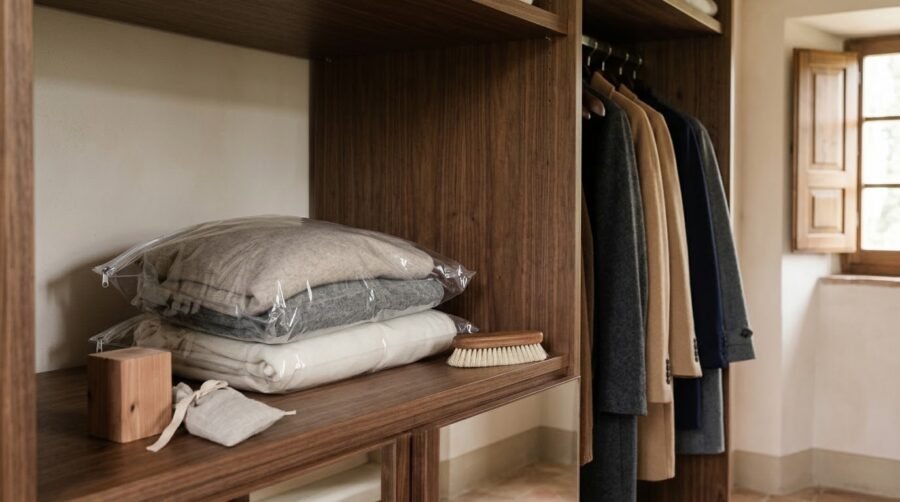
Our first choice is a silver cloth of the kind with fine silver particles woven into it, which grab the sulphur before it gets to your spoons (the Canadian conservators single these out as particularly effective). Failing that, acid-free tissue with no sulphur in it, sealed into a polythene bag, does the job well enough. Cupboards and display cases get a sachet of silica gel against damp plus some activated charcoal (or those anti-tarnish strips) for the gases, swapped on dates written on the cupboard door so it doesn’t depend on anybody’s memory. And newspaper, rubber bands and the old felt-lined cases that smell faintly of breakfast are banned outright.
Lacquer looks like the answer to everything until you try living with it. Conservators generally advise against it for silver that’s used, and we agree: once the coat is scratched, tarnish creeps underneath in odd patches and the whole thing has to be stripped before you can do anything about it.
A silver routine for a working house
Where we work, everyday silver is washed by hand after meals, dried on the spot and given a once-over with the cloth every week. Dinner silver comes out of its wrappings two days early (never that morning), which leaves time to polish without rushing and to check each piece by a window. The rest of that countdown is in how to plan a dinner party, and the table itself in how to set a formal table.
And twice a year we count it all against the inventory. Things wander off in big houses, nearly always innocently (a dessert spoon packed by mistake in a guest’s sponge bag, a fork that surfaces in the vegetable garden in April), and if nobody counts, the first anyone hears of it is a set two short on Christmas Eve. If the house is shutting for the winter, silver goes away first of all, washed and dried and wrapped; closing a summer house properly walks through the order.
There’s a chapter each on silver, crystal, porcelain and linen, plus a weekly schedule to pin up for the team, in The care of fine things. If you’d rather we kept the inventories and the routine for you, that’s part of our household management. Either way, tell us about the house.
Questions
Can you put silver in the dishwasher?
We don't. Dishwasher detergents are harsh, and silver touching stainless steel in the basket can come out with dark spots. Wash it by hand straight after the meal and dry it at once.
Does the baking soda and aluminium foil method damage silver?
It reverses the tarnish chemically rather than rubbing it off, but it leaves a flat, slightly matte finish and treated pieces tarnish faster. It is fine for everyday cutlery in a pinch; avoid it on antique, hollow, gilded or mixed-material pieces.
How do you store silver so it doesn't tarnish?
Wrap each piece in a cloth impregnated with silver particles, or in acid-free, sulphur-free tissue inside a sealed polyethylene bag. Silica gel and activated charcoal in the cupboard help. Keep rubber bands, newspaper and old felt away from it.
How often should silver be polished?
As rarely as possible. Silver in daily use needs washing after each meal and a weekly wipe with a polishing cloth; well-stored silver can go months without polishing.
We write the Journal from our own work in private houses in Italy and Switzerland. Every house has its own rules: take what fits yours, and ask us about the rest.