
The question arrives every autumn, with whoever is new on the team, at about four o’clock on the afternoon of the first big dinner. There’s a dessert spoon in their hand and a look on their face: where on earth does this one go? Fair enough: most people learnt how to set a formal table from a parent, a restaurant or a diagram on a phone, and those three have never once agreed with each other. So here is how we do it in the houses we keep, told the way it actually happens, which is over an afternoon, with a measuring stick and a fair amount of walking round the table.
The idea behind all of it fits in a line. A formal place setting is there so that nobody at the table has to think about it. You sit down, glance at the silver, and you already know there are four courses and fish before meat. If anything on that cloth makes a guest pause, it’s in the wrong place.
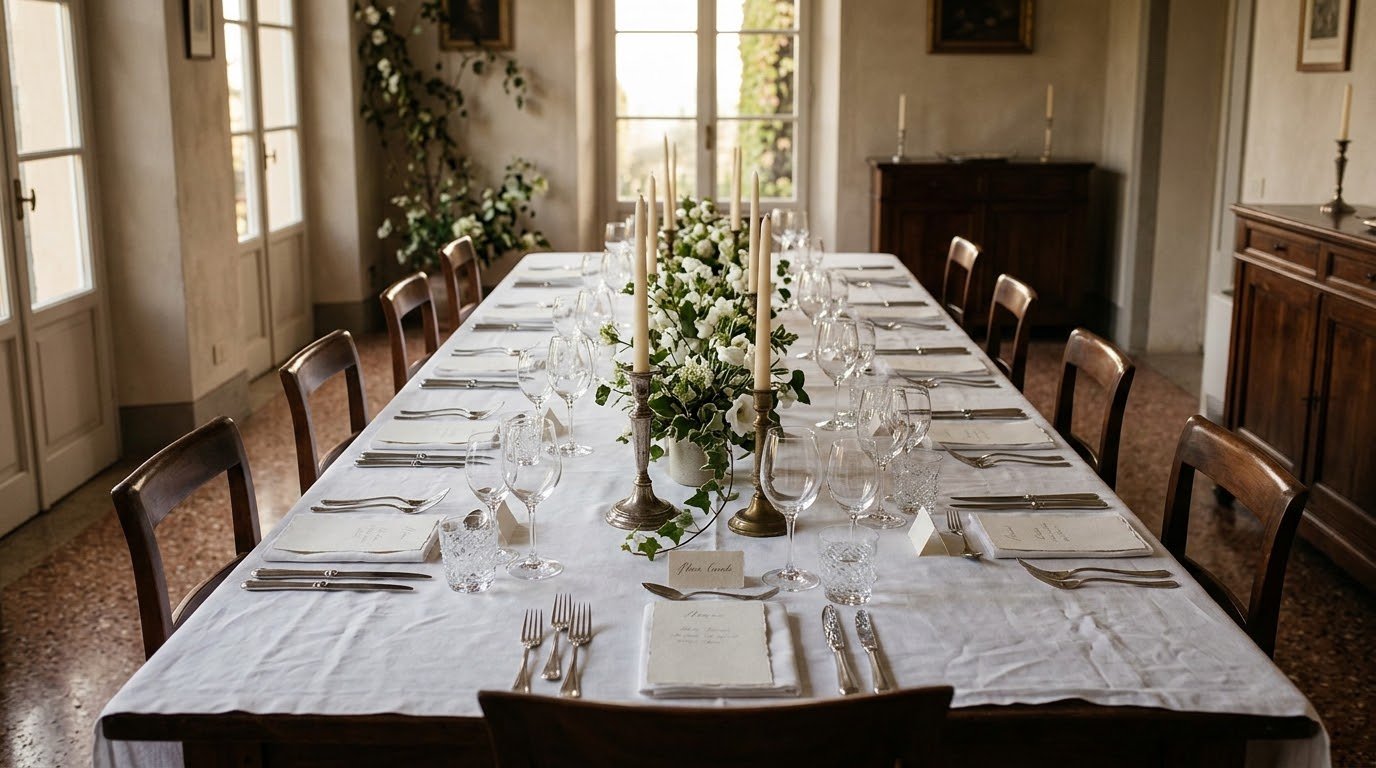
An afternoon laying a table for twelve
Saturday, dinner for twelve, guests called to the table at half past eight. The table gets laid in the afternoon, never at seven, because at seven somebody is always looking for the candles.
15:00 Chairs first
Before a single plate, the chairs. They decide the places, not the other way round. We allow at least sixty centimetres per guest, measured from the middle of one place to the middle of the next, and nearer seventy when the chairs have arms. This is also the hour when someone asks whether thirteen would fit. It would, in the sense that thirteen people can be made to sit at it. Take a leaf out and seat ten properly instead, or add one and seat fourteen with room to lift a glass.
15:20 The undercloth and the cloth
First the molleton, the felt undercloth no guest will ever see and every butler swears by. Without it glasses clink on the wood, hot plates mark the table and the linen never quite lies flat. Then the cloth, ironed on the table if it has to be, with an even drop on all four sides. Ours is about thirty centimetres. Check the corners. The corners are where it goes wrong, and a corner is usually where the host stands to make the toast.
15:40 Plates, and the stick
Service plates go down next, one in the centre of each place, a thumb’s width from the edge of the table. We space them with a stick cut to the right length: an ordinary piece of wood with two pencil marks on it. People who have laid tables for twenty years still use one, because on a long table the eye lies and the stick doesn’t. The service plate, or charger, stays through the first courses with the soup plate or first-course plate on top, and leaves when the main course arrives. A smaller formal dinner can do without one. A good cloth and a good dinner plate will carry it.
16:00 The silver, from the outside in
Here is the rule that does nearly all the work: guests eat from the outside in. One pair of pieces per course, the first course furthest from the plate, so the cutlery reads like the menu.
Forks on the left. Knives on the right, blades turned towards the plate, always, since a blade pointing at a neighbour looks careless even to people who couldn’t tell you the rule. The soup spoon sits to the right of the knives. Fish before meat? Then the fish fork goes outside the dinner fork and the fish knife outside the dinner knife. Exactly one fork lives on the right: the oyster fork, out beyond the spoons, because oysters come first and are eaten with nothing else.
No more than three of any kind on the table. When the menu runs longer, the extra pieces come in with their course. Some houses still lay everything at once, fourteen pieces of silver per guest fanned out like a surgeon’s tray, and the guests spend the first course doing arithmetic.
One person lays one kind of piece all the way round: every dinner fork, then every fish fork, then the knives. Cotton gloves, so the silver stays as clean as it left the pantry. The ends of the handles stop in one straight line, two centimetres or so short of the edge. Stand at the end of the room and that line is what makes a table look right, even to guests who will never notice why. If the silver wasn’t clean when it came out, that is a job for the day before, and our method for cleaning silver explains how we do it without wearing it away.
16:40 Glasses
The water glass stands just above the tip of the dinner knife. Wine glasses go to its right in the order they’ll be used, so the glass for the first wine is the one furthest out, and a flute for a toast or the first course goes on the far right. Five is the most we have ever set. Three is plenty for nearly every dinner. Each glass leaves the table with its course; otherwise, by the main course, every place looks like a small glass shop. Polish them over steam with a lint-free cloth and carry them by the stem, never by the bowl.
17:00 Bread plates, dessert silver, napkins
The bread plate goes above the forks, on the left, with the butter knife lying across it. Many Italian houses serve no butter at dinner at all, so no knife either; we explain why in our guide to Italian table manners. Guests from London or New York will look for it, which is why the butler should know which way the house goes before the first car turns into the drive.
The dessert spoon and fork lie across the top of the place, the fork closer to the plate with its handle to the left and the spoon above it with its handle to the right. That way each hand finds its own piece without anyone working it out. Bringing them in on the dessert plate just before the course is equally correct. Our habit is to lay them up to twelve guests and bring them in for bigger tables, where every centimetre of cloth is already spoken for.
The napkin sits on the service plate or to the left of the forks. Italian manuals prefer the left; we use the plate when a menu card is going to rest on it. Fold it simply. A napkin folded into a swan has been handled for a long time, and everybody at the table knows it.
17:20 Place cards
Place cards stand above the dessert silver, written by hand and large enough to read from standing. Nobody picks up a pen until the titles have been checked (our guide to forms of address deals with ambassadors, clergy and Italian office-holders). Seating is a whole other subject, and a touchy one when there’s an official guest, so have a look at receiving a VIP guest at home before the plan goes to the printer.
18:30 Last things
The centre stays low. Put a tall arrangement in the middle and you’ve turned one dinner for twelve into two dinners for six that can’t see each other. No scented candles and no lilies; the chef didn’t spend all afternoon on that sauce for the room to smell of gardenias. Candles are new, trimmed and tried once in the afternoon, then left unlit until the guests come through.
Then the last look, the one most people skip. Sit in three chairs (both ends, then somewhere in the middle) and look at the table the way a guest will. Whatever irritates you from there will irritate them. Usually it is a glass a few centimetres out of line, or a card facing the wrong way. Once in a while it is the discovery that you have laid the table for eleven.
How to set a formal table: the rules on one page
| Piece | Where it goes | Worth knowing |
|---|---|---|
| Service plate | Centre of the place, a thumb’s width from the edge | Removed when the main course arrives |
| Forks | Left of the plate, first course outermost | The oyster fork is the exception, on the far right |
| Knives | Right of the plate, blades facing it | Never more than three on the table |
| Soup spoon | Right of the knives | Only if soup is served |
| Glasses | Above the knives: water, then wines to the right | The first wine’s glass is furthest right |
| Bread plate | Above the forks | Butter knife across it, if the house serves butter |
| Dessert spoon and fork | Above the plate | Or brought in on the dessert plate |
| Napkin | On the service plate or left of the forks | Folded simply |
| Place card | Above the dessert silver | Written by hand, titles checked |
Where Italian houses do it differently
The skeleton is the same across Europe. Forks left, knives right, blades in, water above the knife. What changes is the detail, and the detail tends to surprise the guests far more than the staff.
Bread is there to go with the food rather than to open the meal, and plenty of Italian families never put butter on the dinner table: no butter, no butter knife. Often there are fewer glasses as well. Water, a white, a red, and each glass picked for its wine rather than to fill up the place. A few houses still end dinner with whole fruit that guests peel themselves with a fruit knife and fork; those arrive with the fruit bowl and are never laid at the start. And coffee has no place in the setting. Espresso comes after dinner, often in another room. An espresso cup laid at the start of a dinner in Milan would travel down the table as gossip.
The mistakes we see most often
Nearly all of them come from hurry. Everything laid at once, for every course. Knives turned outwards. Glasses bunched up any old way, places shoved together for one more guest, a centrepiece taller than whoever is sitting behind it.
Then there’s the one you only meet in houses that own a great deal of silver: two patterns at one place. Mixed sets around a table can look lovely, as if someone meant it. Inside one place setting they look as if the pantry ran out.
For the whole evening rather than just the table, from the invitations three weeks before to the thank-you notes the morning after, read how to plan a dinner party at home.
We drew all of this to scale, course by course, for tables of four to twenty, in The formal table, together with the glassware, the order of service and the timings for kitchen and dining room. If you would rather have the dinner run for you, table and all, that is part of our household management. Either way, tell us about the house.
Questions
Where does the bread plate go on a formal table?
Above the forks, on the left, with the butter knife laid across it. Many Italian houses serve no butter at dinner, and then the butter knife is left out too.
Where do the dessert spoon and fork go?
Across the top of the place, above the plate: the fork nearer the plate with its handle to the left, the spoon above it with its handle to the right. Bringing them in on the dessert plate just before dessert is equally correct.
How many glasses should you set for a formal dinner?
Three is enough for most dinners: water and two wines. Five is the practical maximum. The water glass goes above the knife and the wine glasses to its right, in the order they will be used.
Does the napkin go on the plate or to the left?
Both are correct. Italian manuals prefer the left of the forks; the service plate works well when a menu card is going to rest on the napkin.
We write the Journal from our own work in private houses in Italy and Switzerland. Every house has its own rules: take what fits yours, and ask us about the rest.