
In July, BBC Travel published a list of the mistakes visitors make at Italian tables, and for a week the Italian papers reprinted it with visible pleasure. Cappuccino with lunch. Parmesan on the clams. Asking the kitchen to swap one thing for another. Rushing a dinner that was meant to last until midnight. Italians enjoy reading about their own rules almost as much as they enjoy breaking them at home. This is our guide to Italian table etiquette as it works in a private house in Italy, where we set and serve tables for families whose guests come from London, New York, Zurich and Milan on the same evening. It covers what the galateo says and what Italians actually do, which is not always the same thing.
Galateo, then and now
The word comes from a book. Giovanni Della Casa wrote Galateo overo de’ costumi, published in 1558, and named it after Galeazzo Florimonte, a bishop whose Latin name was Galatheus. It is a treatise on behaviour, and the table is only part of it, but some of its lines still land. Della Casa disliked people who eat “a guisa di porci col grifo nella broda”, like pigs with their snouts in the swill, never lifting their faces. He also thought it ill-mannered to put your nose over the glass of wine someone else is about to drink, which anyone who has sat next to a wine bore will understand.
That is history. Most of what passes for Italian dining etiquette today is written by people like Samuele Briatore, who chairs the Accademia Italiana Galateo, the writer Barbara Ronchi della Rocca and, for a younger audience, the etiquette consultant Elisa Motterle, plus a great many magazine pages of varying authority. They agree on most things. Where they disagree, we say so, because a guest can hardly be blamed for a rule the experts have not settled.
Bread
Bread at an Italian table keeps the food company. It isn’t a course, and nobody fills up on it while the pasta’s on its way. Expect a basket, or a little plate on your left. Manuals do not even agree on the exact spot: some put the bread plate at the top left, one well-known food site puts it just above the forks. Nobody will mind either way.
Two things matter more:
- No butter, and no little dish of oil and balsamic. Lunch and dinner bread comes plain, and asking for butter is a sweet, instant way of telling everyone you’re not from round here. Breakfast is another matter. Bread dipped in oil and vinegar before the meal is a restaurant habit from abroad; in an Italian house the good oil goes on the food.
- Break it by hand. Small pieces, one at a time, torn rather than cut, and never bitten from the whole roll.
Then there is the scarpetta, the piece of bread used to wipe up the last of the sauce. The formal galateo says no. Most Italian families say yes at Sunday lunch and no at a formal dinner. One Italian food writer, listing the rules everybody breaks, admitted to doing it every day and called it a way of keeping plates clean. In a house with guests, we follow the hosts: if the hostess takes a piece of bread to her plate, the table is free to follow.
Salt and pepper
A formal Italian table has no salt and pepper on it, and this surprises more guests than anything else we do. The food leaves the kitchen seasoned, and a cruet set beside each place reads, to some Italian hosts, as a comment on the cook. Across the Channel and the Atlantic it is the opposite: the cruet set is simply part of laying the table, and nobody gives it a thought.
Should a guest ask for salt, it appears at once, and nobody says a word about it. Asking is never the mistake. Reaching is. Della Casa already warned against stretching across your neighbours, and a recent piece in Gambero Rosso on the history of the saltcellar called helping yourself without asking a small territorial invasion. Ask your neighbour, who passes it along the table rather than across anyone’s plate.
Cheese and parmigiano
If visitors know one Italian rule, it’s the one about cheese and fish. BBC Travel put it down to sea against mountains, two traditions that simply don’t share a plate, and that’s why you’ll never see Parmigiano going anywhere near spaghetti alle vongole. Most Italian cooks keep to it, and a good many simply will not send the cheese out when there is fish in the pasta, however nicely you ask.
Not everyone agrees. In 2019 a London chef refused a diner Parmigiano for his crab ravioli, and who should take the diner’s side but the Parmigiano Reggiano consortium itself, pointing out that the cheese is versatile and that northern Europeans happily grate it over seafood pasta. So it’s a custom, and not an ancient one, rather than a law of physics. In a private house the kitchen decides. If the chef has not sent cheese out with the fish, that is the answer, and a guest does well not to ask.
Cheese for the pasta comes ready grated in a bowl with a little spoon, passed round or offered by the butler. A proper cheese course, when there is one, comes before dessert, as in France. The British do it the other way round, after the pudding and often with port, which is how a British guest ends up sitting there politely, wondering whether somebody forgot the cheese.
How to eat spaghetti, and other pasta
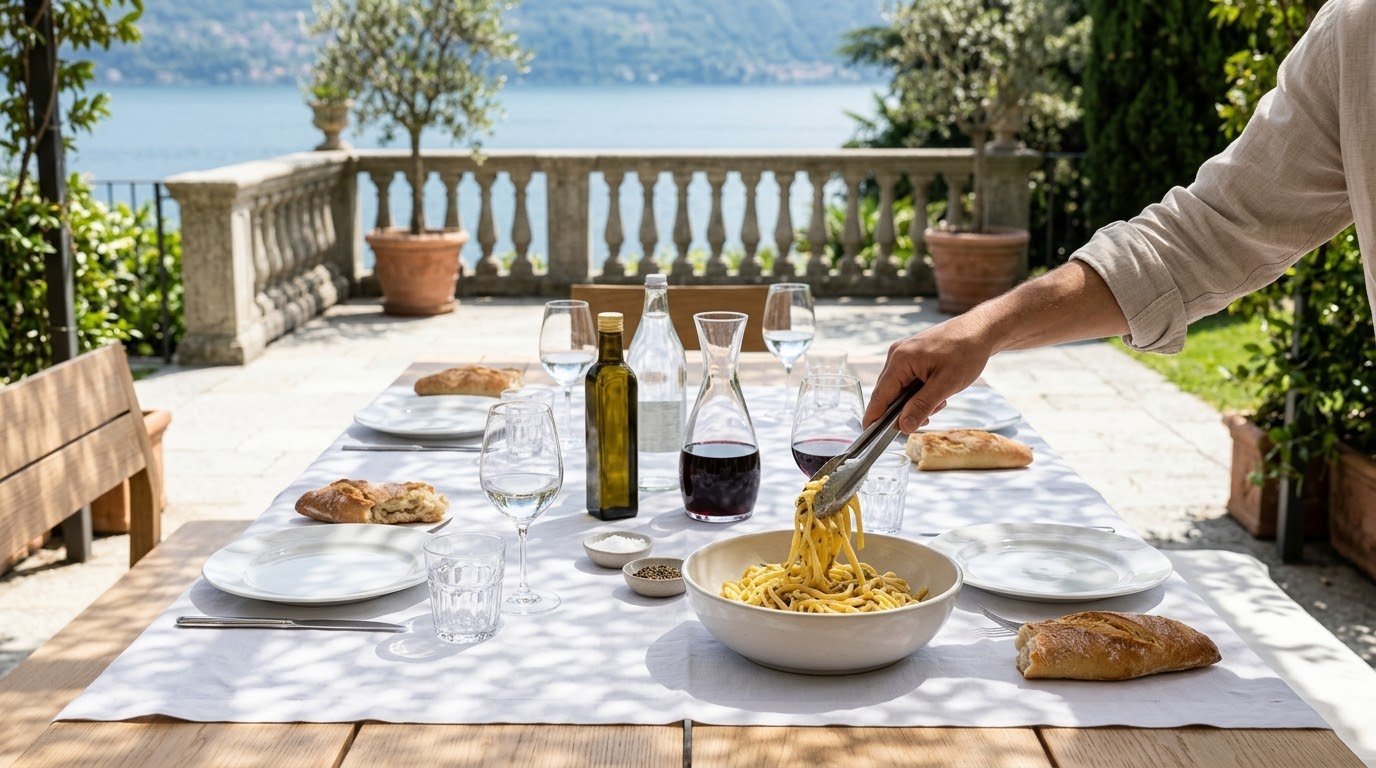
Long pasta gets a fork and nothing else. Catch a few strands, twirl them against the side of the plate, lift. Only a few, mind, because the whole twirl has to go in at once. Spoons are for soup and broth in Italy; a spoon propping up a forkful of spaghetti is, to an Italian eye, something for toddlers and for Italian restaurants abroad. Knives stay well away, and chopping spaghetti into stubs to make life easier is out of the question. Strands too long? Take fewer.
Short pasta you spear or scoop. Risotto is eaten with a fork, spread a little towards the edge of the plate so it cools. Soup and brodo get the spoon. Pasta is a course of its own, the primo. It is not a side dish, and it never shares a plate with the meat, which is one of the few things on which every Italian agrees.
Cappuccino and coffee
Cappuccino is a breakfast drink. Italians have it in the morning, and after about eleven it quietly disappears from the day. After lunch or dinner, the coffee is espresso. BBC Travel’s advice was simply not to order cappuccino in a restaurant; in a house, nobody will refuse to make one, but the cook will remember.
At a dinner at home the coffee is often served away from the table, in the drawing room or on the terrace, with the digestivi. BBC Travel also told its readers not to skip the amaro, which is the most cheerful piece of etiquette advice we have read this year.
Wine and toasts
In an Italian house the host serves the wine, or the butler on the host’s behalf, and guests do not pour for themselves before their neighbours have been served. Glasses get a sensible pour, nowhere near the brim, and you hold them by the stem, a little for elegance and mostly because a warm hand wrapped round the bowl warms the wine too.
The toast is where the galateo and real life part ways most visibly. The Accademia Italiana Galateo advises against clinking glasses and against saying “cin cin”, which its president has called an onomatopoeia with a meaning poorly suited to a toast. Then walk into almost any Italian dinner: within half an hour glasses are clinking and somebody has said cin cin, and nobody has died. At a formal table we side with the Accademia. The glass goes up, you look the person you are toasting in the eye, and then you drink. At a family table, clink if the family clinks. When you are the person being toasted, do as the British do and do not drink to yourself.
The host’s role
At an Italian table the rhythm belongs to the hosts, and a guest who watches them will rarely put a foot wrong.
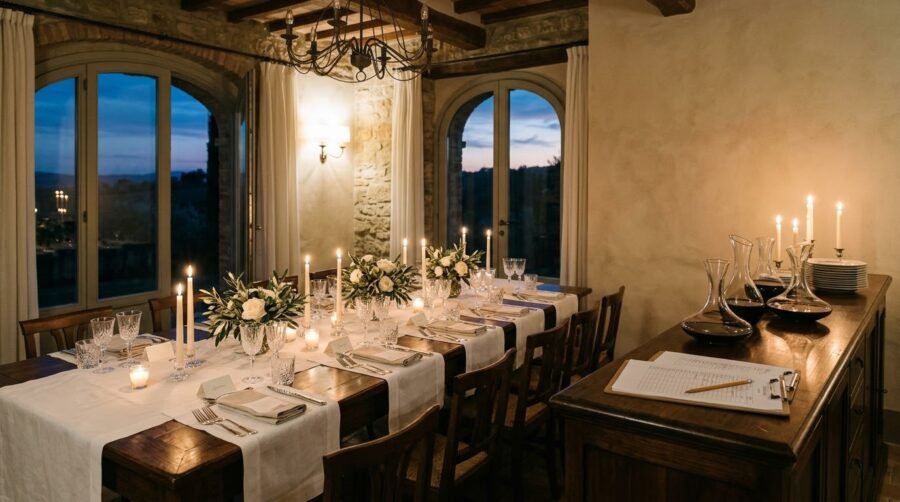
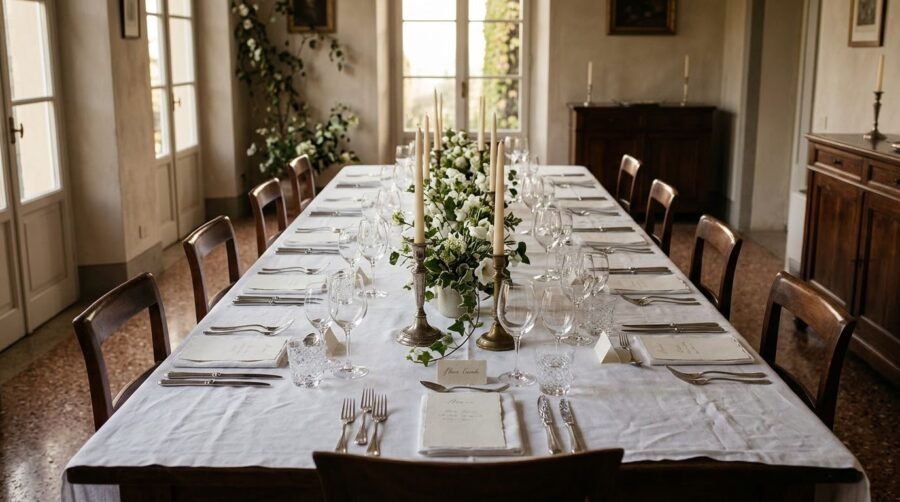
- Seating. Most Italian manuals seat the host and hostess at the two ends of the table, facing each other down its length. The guests to be honoured sit on their right: a woman to the right of the host, a man to the right of the hostess. Men and women alternate where possible, and married couples are separated. Engaged couples, one Italian manual says firmly, are not.
- Starting. Wait until everyone has been served, or until the hostess or host begins. A guest who starts first will be noticed, if not mentioned.
- Diets. Elisa Motterle puts the duty on the host to ask, at the moment of inviting, whether a guest cannot eat something, and on the guest to say so.
- “Buon appetito”. Strict galateo says you do not wish someone a good appetite, on the grounds that appetite should not come into a formal meal. Among family and friends, as one Florence magazine put it, it does no harm, and most Italians say it without thinking. At a formal dinner we leave it to the hosts. If the hostess says it, answer “altrettanto”.
- The order of courses. Antipasto, primo, secondo with its contorno, then cheese, dessert, coffee. You may skip a course. You may not reorder them, and asking for the pasta with the meat confuses everybody.
What visitors get wrong
From the tables we have served, roughly in order of how often we see them:
- Ordering cappuccino after dinner, or with lunch.
- Asking for Parmigiano on seafood pasta.
- Taking a knife to the spaghetti, or a spoon.
- Asking for butter, or for the famous little dish of oil and balsamic.
- Expecting the salad first. In Italy it comes with or after the main course, as a contorno.
- Hands in the lap. Here, as on most of the Continent, both hands stay where people can see them, wrists resting on the edge of the table, elbows off.
- Swapping the fork into the right hand after cutting, American style. Fork left, knife right, and there they stay.
- Asking the kitchen to swap things. BBC Travel made the same point: unless it is an allergy or a real dietary need, eat what the house is serving.
- Rushing. Dinner in Italy is the evening itself, not something to get through before the car comes.
Italian table etiquette and Anglo-Saxon habits, side by side
| At the table | Italian house | British or American house |
|---|---|---|
| Bread | No butter at lunch or dinner; broken by hand | Butter is usual; a bread plate with its own knife |
| Salt and pepper | Not on a formal table; asked for if wanted | On the table as part of the setting |
| Hands | Visible, wrists on the table edge | American custom: the free hand in the lap |
| Fork | Left hand throughout | American custom: switched to the right hand after cutting |
| Salad | With or after the main course | Often before it, in the American way |
| Cheese | Before the dessert | In Britain, traditionally after the pudding |
| Coffee | Espresso after meals; cappuccino in the morning | Any coffee, any time |
| Toasts | Formal galateo: glasses raised, not clinked | Glasses often clinked; you do not drink to yourself |
| Finished | Knife and fork side by side, upright in the plate | Side by side, often on the diagonal in America |
| “Enjoy your meal” | “Buon appetito”, frowned on by strict galateo, said by everyone else | No real equivalent; usually nothing is said |
A note on that row about finishing. Italian guides mostly ask for knife and fork parallel and upright in the plate, and during a pause, resting in the plate and never crossed. Plenty of Italian hosts are perfectly happy with the diagonal. What actually matters is that the cutlery stays on the plate and never goes back onto the cloth.
None of this is a test, and a host who treats it as one has missed the point of the whole exercise. The point of a galateo is that nobody at the table should feel awkward, the foreign guest least of all. When we set a table for a mixed party, we brief the butler on the two or three habits that will come up that evening, and we make sure the Italian side of the table does not comment on them either.
The place setting itself, glass by glass, is in how to set a formal table, and the evening around it in how to plan a dinner party. If you would like the whole system on paper, from the layout of a formal place setting to the order of service and the timing of each course, it is in The Formal Table. If the guest list includes titles, our one-page forms of address card, free to download, covers the place cards, and the long version is in our guide to forms of address. For a guest who arrives with an office and a protection officer, start with receiving a VIP guest at home. And when the house needs a butler who knows both customs and when to use each, our household staff interview questions will help you find one.
Questions
Can you put Parmigiano on seafood pasta?
Most Italian cooks say no, and many will not bring cheese to the table when the pasta has fish in it. It is a custom rather than a law: in a private house the kitchen decides, and if the chef has not sent cheese out with the fish, a guest should not ask for it.
Is it rude to say "buon appetito"?
Strict galateo says you do not wish anyone a good appetite at a formal meal. Among family and friends it does no harm, and most Italians say it without thinking. At a formal dinner, leave it to the hosts; if the hostess says it, answer "altrettanto".
Where do the hosts sit at an Italian table?
Most Italian manuals put the host and hostess at the two ends of the table, facing each other, with the guests to be honoured on their right: a woman to the right of the host, a man to the right of the hostess. Men and women alternate where possible, and married couples are separated.
We write the Journal from our own work in private houses in Italy and Switzerland. Every house has its own rules: take what fits yours, and ask us about the rest.
Sources
- Giovanni Della Casa, Galateo overo de’ costumi (1558), Liber Liber edition
- Sky TG24, the BBC Travel guide to mistakes in Italian restaurants (31 July 2026)
- Il Post, on toasts and the Accademia Italiana Galateo (31 December 2023)
- The Florentine, Buon appetito (or not): etiquette at the Italian table
- Dissapore, Bon ton a tavola: 5 violazioni socialmente accettate (9 October 2015)
- Dissapore, cheese on fish: the Parmigiano Reggiano consortium replies (30 April 2019)
- Dissapore, Come apparecchiare la tavola (8 November 2019)
- Vorwerk Bimby magazine, Galateo a tavola (22 November 2023)
- Vorwerk Bimby magazine, Galateo per ospiti a pranzo e a cena (13 July 2017)
- Il Fatto Quotidiano, Elisa Motterle on the festive galateo (24 December 2021)
- Gambero Rosso, “Mi passi il sale?” (29 June 2025)