
In a private house, a VIP is not defined by fame. It is any guest whose visit brings other people with it. A private secretary who wants a timetable. A protection officer who asks to see the back door before he sees the drawing room. Drivers who need somewhere to wait, and to eat, for six hours. Sometimes a dog. Our VIP guest protocol starts the moment the date is fixed, and it ends two days after the car has gone, when the report is written. What follows is how to receive a VIP guest the way we do it, step by step, for a minister, a head of a family office, a bishop or a royal guest staying a night or two in a house in Italy or Switzerland. It changes from house to house. The order of things does not.
The VIP guest protocol, from date to departure
By the time the car turns into the drive, most of the work is already behind us. That is the whole trick, if there is one: a visit that looks effortless on a Saturday was started on a Tuesday six weeks before. The table below is the skeleton we hang every visit on. A weekend with a guest who travels with security wants about six weeks of it; a dinner with no overnight stay can be done in three, though we would rather have four.
| When | What happens | Who |
|---|---|---|
| Six weeks before | Date and length of stay confirmed in writing. One contact named on each side. Guest sheet opened. | Host, guest’s office, house manager |
| Four weeks | Questions sent to the office: form of address, entourage, cars, arrival time, diet, medical needs, religious practice, security. Extra staff and suppliers booked, without the guest’s name. | House manager |
| Three weeks | Advance visit by the guest’s team. Room allocated, route agreed, parking and rest room for drivers and officers fixed. | House manager, estate manager, guest’s security lead |
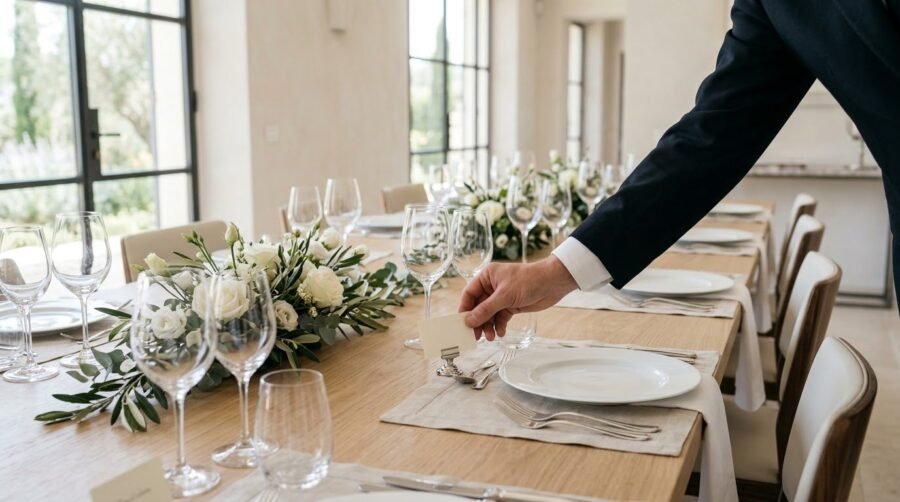
| Ten days | Menus drafted against the diet answers. Seating plan and place cards. Confidentiality agreements signed by anyone new. | Chef, butler, house manager |
| 48 hours | Full team briefing. Rooms dressed and checked. Arrival walked through at the real time of day. | Whole team |
| Day of arrival | Fifteen-minute briefing in the morning. Arrival. Plan for the visit left in the guest’s room. | Whole team |
| Departure | Luggage down early, room swept with the guest’s assistant, cars checked, thanks. | Housekeeper, driver, host |
| Within 48 hours after | After-visit report written, guest sheet updated, unneeded data deleted. | House manager |
Two habits hold the timeline together. One person in the house speaks to one person in the guest’s office, and everyone else goes through them. And every answer is in writing, because a preference heard on the phone in week four will have changed shape by week one. A guest who “doesn’t drink” may turn out to drink only champagne, and the kitchen needs to know which.
The questions we send to the guest’s office
An office that looks after a public person has answered the same questions a hundred times, and what it dislikes is not the questions but getting them in dribs and drabs over a month. So we send one list, four weeks out, and we ask for it back within a fortnight. The first thing on it is the name: how the guest is addressed, out loud and on an envelope, and how the surname is actually said (for the forms themselves, see forms of address). Then who comes too, which is never nobody: a spouse, an assistant, protection officers, a driver, and anyone else who will need a bed or a plate. Then how they are travelling. Which flight, which car, what time they honestly expect to turn up (not the time on the itinerary), and who’s meeting whom at the airport or the station. “Someone will be there” isn’t a plan, it’s a prayer.
Then come the three awkward ones. People are shy about asking them, and they are the ones that decide whether the weekend works. Diet, with allergies and how bad they are, intolerances, plain dislikes, religious rules and any fasting. Anything medical we had better know: a bad knee that will not love the stairs, a medicine that has to live in a fridge, the number of a doctor who speaks the guest’s language. And religious practice, which comes up more often than you would think. Prayer times. A quiet room. Whether there is a service nearby they would like to go to on the Sunday. After that come the small things that make a guest feel known, the temperature of the room, the pillows, which newspapers, what hour breakfast is, whether they swim; how all that becomes a room is in how to prepare a guest room. And last, what is private. A few guests are happy for the village to know they are coming. Most are not, and the office will say which.
The host gets the same list with one more question: who else is coming, and does the guest know them? With a member of the Swiss Federal Council, go through the office from the start. Even the diplomatic corps, under the Confederation’s 2026 Protocol Regulations, sends its invitations to a lunch or dinner in a councillor’s honour via Protocol, and a private house has no reason to be bolder than an embassy.
The advance visit
When a guest travels with security, their team will want to see the house before the guest does. Sometimes it is the protection lead alone, sometimes the lead with the private secretary. Give them a morning, and give them the person who knows the house best, which is not always the person who happens to be free that day. The gardener who has opened the gates every morning for eleven years knows more about the back lane than the manager who arrived in March.
What they want to see is fairly predictable once you have done it twice. The route from the car to the front door, and from the door to the bedroom, walked at a normal pace. Every way in and out of the house. The windows of the guest’s room and what they look onto. Where the nearest hospital with an emergency department is, and how long it actually takes to get there on a Friday evening, which is never what the map says. After that the questions get domestic. Where will the officers sit down and eat? Where do the cars wait? Who exactly is on duty that weekend, and is anybody new? Answer plainly. A staff list with names and roles is a reasonable thing to hand over. Dates of birth and passport numbers are a bigger request, and we give those only with each person’s agreement, for that visit and that purpose, and we say so to the officer, who will not be surprised.
We are stubborn about one detail. The walk-through happens at the hour the guest will actually arrive, even if eleven in the morning suited everyone’s diary better. A terrace that is lovely at ten looks straight into the low sun at seven, and the guest spends the first ten minutes squinting at the host.
Arrival and departure
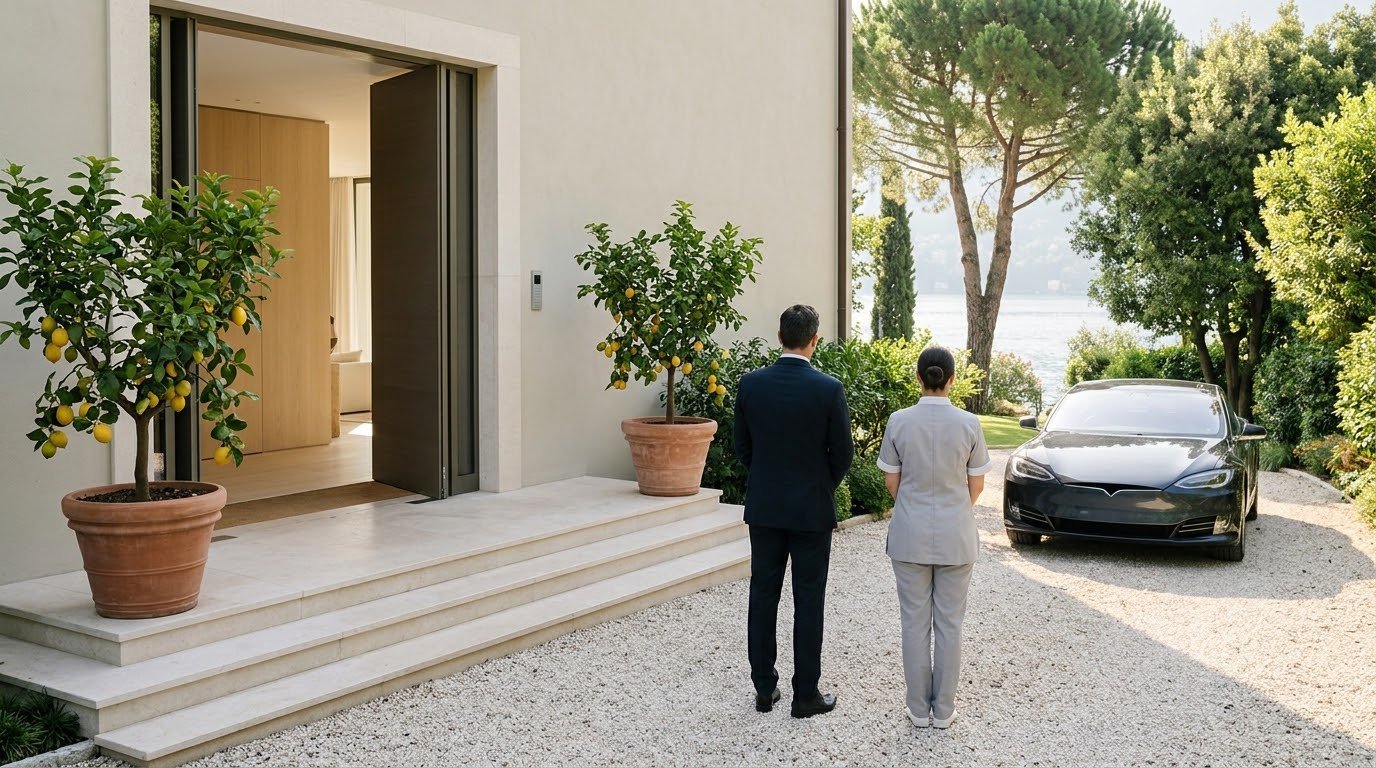
The first five minutes colour everything that follows. The host should be at the door, full stop. If the host genuinely cannot be, the house manager is, and says so in the first sentence rather than the third: “Welcome, Your Excellency. Signora Bianchi is on her way back from Milan and asked me to look after you until she arrives.”
A handful of things are settled in advance, because they cannot be improvised at the car door. Who opens it, for a start: if there is a protection officer, it is the officer, and the staff stay back until they are invited forward. Bags go in through the service door and straight up to the room, and they are unpacked only if the office said they should be; some guests would rather die than have a stranger fold their shirts. Nobody loiters in the drive, no gardener pausing to look, no phone held up behind a curtain, and anyone not needed for the arrival keeps out of sight. There is a tray ready with water and something cold without alcohol, and wine too if the host likes, though in our experience most guests want only the water after a drive. And in the room, on the desk, a card with the times of the visit, the names of the people looking after them and a telephone number that rings in the house, not in an office in another city.
With a royal guest, the Royal Household’s own advice covers the greeting: “Your Royal Highness” the first time, then “Sir” or “Ma’am”, with a neck bow or a small curtsy if you wish. The Household is clear that none of it is obligatory. We still brief the staff on the traditional forms, because a housekeeper would rather know them and not need them.
Departures go wrong more often than arrivals, because by then everyone has relaxed. We bring the luggage down half an hour early. The room is swept with the guest’s assistant before the car leaves, not after, and the usual suspects are always the same: chargers, reading glasses, the watch by the basin, the book on the night table. Someone checks that the drivers have eaten. The host walks the guest to the car. The staff do not line up in the drive unless it is a state occasion, and in a private house it almost never is.
The staff briefing
Forty-eight hours before the arrival, the whole team sits down for half an hour. Everyone, and we mean the people who will only work the dinner and the extra waiters from the agency, who are the ones most likely to pull out a phone. On the morning itself there is a second, shorter one: fifteen minutes, standing up in the kitchen with coffee, mostly to confirm that nothing has changed overnight. Something usually has.
Everyone walks out of that first briefing holding the guest sheet. It’s one page, no more: the name and how it’s pronounced, how to address them, who’s in the party, which room, the diet in plain words, the times. Then we say the rules out loud, yes, even to the people who could recite them in their sleep. No photographs that weekend, of the guest, the cars, the table or the house, and phones live in the staff room while on duty. No autographs and no selfies, and no mention of the visit to anyone, during or after, which includes family at home. You speak to the guest when spoken to, and you keep it to the service, with one exception we like: if a guest wants to talk about the garden, the gardener may talk about the garden for as long as the guest wishes. If anybody outside the house asks about the visit, on the phone, at the gate, over a coffee at the village bar, there’s exactly one answer: sorry, can’t help, but I’ll happily pass your number to the house manager. Something will go wrong at some point (it always does), and when it does, the house manager hears about it first and quietly, and nobody tries to bury it. A dropped glass is nothing. A dropped glass swept under a sideboard is a problem.
Then every job gets a name. Who serves the guest at table, who looks after the officers and the drivers, who answers the door, who stays by the phone. The officers in particular eat at strange hours and may want a hot meal at midnight, and somebody has to own that, or they will end up in the kitchen at one in the morning making their own sandwiches.
Discretion and security
Discretion is mostly logistics rather than mystique. Suppliers get a date, a number of covers and a delivery time, never the guest’s name. Deliveries are addressed to the house manager. Menus and place cards are printed in the house, on the ordinary printer, not by a printer in town. The guest wifi is a separate network. The visitors’ book comes out only if the office has said yes.
The guest sheet itself deserves some care, because by now it holds personal data, and some of it is the sensitive kind. The GDPR is strict here. Anything revealing a person’s religious beliefs, and anything about their health, sits in the special categories of Article 9, and you may only process it on narrow grounds, explicit consent being the obvious one. Have a look at a typical guest sheet with that in mind. A request for a halal meal tells you someone’s religion. A nut allergy is health data. The Swiss, in their Federal Act on Data Protection (in force since September 2023), file religious views and health in the very same sensitive drawer. Both laws let off purely personal or household use, and a family jotting down notes about its own friends clearly falls inside that. A house where managers and agencies hold guest files? That’s murkier, and we’d rather not learn the answer in front of a judge, so we simply act as though the rules apply. It’s not much of a burden, honestly. Ask only what the visit needs. Keep it all in one place. The diet goes to the kitchen, not the whole team, and whatever’s no longer needed gets deleted once the report’s written.
Protection officers turn out to be very easy guests once you stop treating them like characters from a spy film. What they want is a room near the entrance, a key or a code, the staff list, a hot meal at whatever odd hour they happen to eat, and a place for the car. What they carry, and where they’ll stand, is none of your business, so don’t ask. They will tell you what you need to know, and not a word more, and both sides are happier that way.
Dietary and religious needs
Italian etiquette writers put this squarely on the host. Elisa Motterle, for one, tells hosts to ask, at the moment of the invitation, whether there is anything a guest cannot eat. We agree with her, with one addition: ask about dietary requirements early, in writing, and ask the person who will actually be eating, through their office. “I think he doesn’t eat meat”, from a host’s memory, has wrecked more dinners than any chef ever did. For allergies, our kitchens work from the EU’s fourteen, the list in Regulation 1169/2011 (cereals containing gluten, crustaceans, eggs, fish, peanuts, soybeans, milk, tree nuts, celery, mustard, sesame, sulphites, lupin and molluscs). It was written for restaurants, not private houses, but we’ve yet to find a better list, and it makes any chef read every sauce and every stock twice over. And we ask straight out how bad the allergy is. An intolerance and a reaction that ends with an adrenaline injector are miles apart, and the kitchen has to know which end of that road it’s on.
Religious practice takes more than a menu, and it’s where you find out whether a house really knows its business. Our kitchens and housekeepers work from the table below, but the guest’s office always knows more, so treat it as a place to start rather than the final word.
| Practice | What the house does |
|---|---|
| Halal | No pork, no alcohol, and that means the splash of wine in the sauce and the liqueur in the pudding too. Meat comes from a certified butcher; the bigger Italian and Swiss cities have them, as long as you order ahead. |
| Kosher | For a strictly observant guest, a private kitchen cannot be made kosher in a week, whatever anyone tells you. We order sealed meals from a certified caterer and serve them as they arrive, seals intact, on the guest’s say-so. A guest who keeps a lighter version will have an office that tells you exactly what’s wanted. |
| Hindu and Jain guests | Plenty of Hindu guests skip beef, and a good many don’t eat meat at all. Many Jain guests also steer clear of onion, garlic, potato and other roots. Ask; don’t guess. |
| Fasting | During Ramadan an observant Muslim guest won’t eat or drink from dawn to sunset, so dinner is timed for the very minute the fast ends, with dates and water waiting on the table. Some Catholic guests keep Fridays and the fasts of Lent. Yom Kippur is a full fast. |
| Prayer | A quiet, clean room, and the direction of Mecca worked out before anyone has to ask. |
| The Sabbath | An observant Jewish guest spending the Sabbath in the house raises questions nobody thinks of in advance: electric locks, key cards, lights on timers, and whether the synagogue is within walking distance. |
| Greetings | A few guests, for religious reasons, will not shake hands with someone of the other sex. Our staff wait for the guest to offer a hand first. |
One more thing, small and often forgotten. Always have a good drink without alcohol on the tray for the toast. Nobody should have to raise an empty glass.
The after-visit report
Within two days of the departure, while people still remember who said what, we write a short report for the host. Two pages at most, and the second page is usually the table. It is the document that makes the second visit easier than the first.
| Section | What goes in |
|---|---|
| Plan and reality | Where the visit departed from the timetable, and why |
| What the guest liked | Only what was seen or said, not guessed: the second helping, the walk they asked to repeat |
| Incidents | Anything that broke, went missing or went wrong, and what was done |
| Next time | Changes to rooms, timings, menus, staffing |
| Costs | Spending against the budget, extra staff hours |
| Data | What we keep on the guest sheet, with the guest’s agreement, and what we have deleted |
| Thanks | Who on the team deserves a word from the host |
The report goes into the House Book, in a section only the host and the house manager can open. Next year, when the same office writes about a new date, the first answer is already on file. None of this is glamorous. It is ordinary house management, and it is a good part of what a house manager actually does all day.
We have reduced the morning of the arrival to a single sheet: our VIP arrival checklist, free to download and printed for the staff room. The full system, with the questions for the office, the guest sheet, the briefing script and the report template, is in The Protocol Book. And if you would rather hand the whole visit to someone who has run many of them, that is what our household management is for, led by one of us in person.
Questions
How far ahead should a VIP visit be planned?
About six weeks for a weekend visit by a guest with security, about three for a dinner without an overnight stay. The date and the length of the stay are confirmed in writing first, and the questions go to the guest's office four weeks out.
What should you ask the guest's office?
How the guest is addressed and how the name is pronounced, who travels with them, cars and arrival times, diet and allergies with their severity, medical needs, religious practice, small preferences, and what must stay private. Send it as one list, four weeks before the visit.
Who opens the car door when the guest arrives?
If there is a protection officer, the officer. The staff stay back until invited, the host is at the door, and the luggage goes in through the service door, straight to the room.
We write the Journal from our own work in private houses in Italy and Switzerland. Every house has its own rules: take what fits yours, and ask us about the rest.
Sources
- Regulation (EU) 2016/679, General Data Protection Regulation (Articles 2 and 9)
- Federal Act on Data Protection (FADP), SR 235.1 (Articles 2 and 5)
- Regulation (EU) No 1169/2011 on the provision of food information to consumers (Annex II)
- The Royal Household, Greeting a member of the Royal Family
- Federal Department of Foreign Affairs, Protocol Regulations of the Swiss Confederation (2026)
- Il Fatto Quotidiano, Elisa Motterle on hosting, diets and intolerances (24 December 2021)