
Forms of address worry people more than almost anything else in a formal house. A seating plan can be redrawn at six in the evening and the fish can be swapped for veal, but greet the wrong guest with “Your Grace” at the door and the evening starts crooked. This guide sets out how to address an ambassador, a duke, a cardinal and the other guests a private house in Italy or Switzerland is likely to receive, out loud and on paper. We work from it ourselves; the sources are at the end. One rule comes before all the others: ask the guest’s office.
The rule before the rules: ask the office
Every guest of rank has someone who keeps the diary. A private secretary, a chancery, a chief of staff, a bishop’s secretary. That person will tell you in one email how their principal likes to be addressed, and they would far rather be asked than have to correct you afterwards. The books give you the correct form. The office gives you the form this person actually uses, which is not always the same thing: some women life peers prefer “Baroness” to “Lady”, and Debrett’s, while calling it technically incorrect, says the preference should be respected.
About ten days before the visit we ask, in writing:
- How should he or she be addressed in conversation, at the greeting and afterwards?
- What goes on the envelope, and what goes on the place card?
- Will a husband, wife or partner come too, and under what name?
- And how do you say the name? Ask even when you are sure. Cholmondeley is “Chumley”, and the British are not the only ones with surnames like that.
Whatever the answer, we write it in the House Book, with the date and the name of the person who told us. So the next time that guest comes, nobody has to ring round, and nobody has to guess.
How to address an ambassador
Ambassadors are the ones people ask us about most. Not surprising, really: they come to dinner a good deal more often than dukes do. The rule here is international. An ambassador stands for a head of state, so the style is “Excellency”. You say “Your Excellency” once, when you greet them, and after that it’s “Ambassador” or simply their name; Debrett’s advice is the same, at least one “Your Excellency” and then “Sir”, “Ma’am” or the name. On paper, a formal letter starts with “Your Excellency”. If you fancy the full old-fashioned ending, it closes “I have the honour to be, with the highest consideration, Your Excellency’s obedient servant”. A friendly note is much easier: “Dear Ambassador”, then “Yours sincerely”, and you’re done.
Four details catch people out.
- The title belongs to the posting. A British ambassador gets “His Excellency” or “Her Excellency” only in the country where they’re accredited, never back in the United Kingdom. So the British ambassador to Rome is “Excellency” at a dinner on Lake Como, and plain “Ms” once she’s home in Kent.
- A woman is an ambassador. Not an ambassadress, says Debrett’s. Italy’s diplomatic list agrees in its own way: women heads of mission appear as “S.E. Sig.ra”, followed by the name and “Ambasciatore Straordinario e Plenipotenziario”, with the masculine noun.
- The spouse has no title. An ambassador’s wife or husband is Mrs, Mr, Signora or Signor. Debrett’s notes that a woman ambassador’s husband receives no style at all. On a place card he is simply “Mr Bergen”.
- The nuncio wears two hats. The Pope’s ambassador is an archbishop and a head of mission at once. Italy’s diplomatic list puts him first, ahead of every ambassador, as “S.E. Rev.ma Mons.”, and “Your Excellency” or “Eccellenza” works for both of his jobs.
Switzerland is plainer. The Swiss Armed Forces’ protocol guide writes to a foreign ambassador as “Sehr geehrter Herr Botschafter” and does not use “Exzellenz” at all. Americans tend to say “Mr Ambassador” or “Madam Ambassador”. We brief the staff on “Your Excellency” for every ambassador, because nobody has ever been offended by it.
| Where | At the greeting | Afterwards | Letter opens | Envelope |
|---|---|---|---|---|
| United Kingdom (Debrett’s) | Your Excellency | Ambassador, Sir or Ma’am, or the name | Your Excellency (formal); Dear Ambassador (social) | His/Her Excellency The Ambassador of Norway, or His/Her Excellency Mr/Ms [name] |
| Italy | Eccellenza, or Signor Ambasciatore | Ambasciatore | Eccellenza, or Signor Ambasciatore | A Sua Eccellenza il Signor / la Signora [name], Ambasciatore di [country] |
| Switzerland (German-speaking) | Herr Botschafter / Frau Botschafterin | The same, or the name | Sehr geehrter Herr Botschafter / Sehr geehrte Frau Botschafterin | Herr Botschafter / Frau Botschafterin, name, Embassy |
| United States (common usage) | Mr Ambassador / Madam Ambassador | Ambassador, or the name | Dear Mr Ambassador / Dear Madam Ambassador | His/Her Excellency [name], Ambassador of [country] |
Royals and peers in the United Kingdom
The Royal Household’s own guidance on how to address the King is shorter, and more relaxed, than most people expect. On presentation to the King you say “Your Majesty”, and after that “Sir”. For the Queen it is “Your Majesty”, then “Ma’am”, pronounced with a short “a”, as in “jam”. For the rest of the Royal Family it is “Your Royal Highness” once, and then “Sir” or “Ma’am” for the rest of the conversation. There used to be a bow from the neck for men and a small curtsy for women. Some guests still do it, most now shake hands, and nobody minds either way. The Household says plainly that there are no obligatory codes of behaviour, so guests can choose. Staff are not guests, and we brief them on the traditional forms.
Letters are less fierce than their reputation. For a formal letter the Household suggests opening with “Sir” and closing “I have the honour to be, Sir, Your Majesty’s humble and obedient servant”, then adds that this is by no means obligatory. Other members of the family are reached through their private offices, which is also where any visit gets planned.
Peers are where most mistakes happen, because the spoken form and the written form part company, and most questions about how to address a duke come down to that gap. A duke is “The Duke of [place]” on the envelope. In conversation Debrett’s has “Good morning, Duke”, and that is what his social equals say. “Your Grace” is the formal form, the one staff use. American guides such as Robert Hickey’s give “Your Grace” for everyone, so British and American guests at one table can sound as if they were at different dinners.
Below the dukes it gets simpler, thank goodness. Speaking to a marquess, an earl, a viscount or a baron, you just say “Lord [title]”, and their wives are “Lady [title]”. “Earl” and “Baroness” are for envelopes and printed lists, Debrett’s says, the women life peers we mentioned above being the exception. Knights and dames take the first name: “Sir John”, “Dame Maggie”, never “Sir Smith”. The wife of a knight or baronet is “Lady Smith”, without her first name.
| Guest | At the greeting | Afterwards | Letter opens | Envelope |
|---|---|---|---|---|
| The King | Your Majesty | Sir | Sir | His Majesty The King |
| The Queen | Your Majesty | Ma’am (as in “jam”) | Madam | Her Majesty The Queen |
| Prince or princess (Royal Highness) | Your Royal Highness | Sir / Ma’am | Sir / Madam | His/Her Royal Highness The Prince/Princess [title] |
| Duke, duchess | Duke / Duchess (socially); Your Grace (staff, formal) | The same | Dear Duke / Dear Duchess (very formal: My Lord Duke) | The Duke / Duchess of [place] |
| Marquess, earl, viscount, baron | Lord [title] | Lord [title] | Dear Lord [title] | The Earl of [place]; The Lord [title] for a baron |
| Their wives | Lady [title] | Lady [title] | Dear Lady [title] | The Countess of [place]; The Lady [title] |
| Knight, dame | Sir John / Dame Mary | The same | Dear Sir John / Dear Dame Mary | Sir John Smith / Dame Mary Smith |
Italy is another story. The Constitution is blunt: “I titoli nobiliari non sono riconosciuti”. Noble titles are not recognised, and the predicates of titles that existed before 28 October 1922 count as part of the name. Socially, many families still use them: a guest introduced as “il conte” is “Signor Conte” to the staff.
Italian and Swiss authorities
The Italian state abolished most of its honorifics on paper and kept many of them in conversation. The President of the Republic is “Signor Presidente”. So, in speech, are the presidents of the two chambers and the President of the Council of Ministers. A minister is “Signor Ministro” or simply “Ministro”. Deputies are “Onorevole”, which, as Il Post has pointed out, is custom rather than law, inherited from the parliament of the old Kingdom of Sardinia. Senators are “Senatore” or “Senatrice”.
“Eccellenza” is the awkward one. A royal decree of 1927 gave it to the highest offices of state; a decree of 1945 ordered that its use should stop, but that decree was never converted into law. In practice prefects and the judges of the Court of Cassation are still widely called “Eccellenza”, and not using the word is not a mistake either. Ambassadors and bishops keep it for their own reasons, diplomatic and ecclesiastical.
Then there are the professional titles. Italy hands them out generously. Anyone with a degree is “Dottore” or “Dottoressa”; a lawyer is “Avvocato” and an engineer “Ingegnere”, said to their faces and meant. If a guest arrives on Friday introduced as “l’avvocato”, he is “Avvocato” to the staff until his car leaves on Sunday. Feminine forms are unsettled. Some women in office want “la ministra”, others insist on the masculine. Ask.
Italy has its precedence written down, which helps when one dinner brings several office-holders. The order lives in a decree of the President of the Council of Ministers, dated 14 April 2006 and touched up in 2008. No private house is bound by it, but if a prefect and a regional president are both coming, it settles the seating before anyone takes offence.
At home, Switzerland does without “Excellency” for its own office-holders. A member of the Federal Council is simply “Herr Bundesrat” or “Frau Bundesrätin”, and that is how the letter opens too: “Sehr geehrter Herr Bundesrat”, “Sehr geehrte Frau Bundesrätin”. One thing catches people out. The presidency passes round the seven every year, so “Herr Bundespräsident” in December is plain “Herr Bundesrat” again on the first of January, and a place card printed in advance can be wrong by the time of the dinner. In the cantons the minister is “Herr Regierungsrat” where German is spoken, “Monsieur le Conseiller d’État” in Geneva or Vaud, “Signor Consigliere di Stato” in Ticino. The head of a commune is “Herr Gemeindepräsident”.
Switzerland brought in new Protocol Regulations on 15 June 2026. They’re written for official events, not for dinner at someone’s house, but there’s one line in them we’d happily borrow. If the diplomatic corps wants a Federal Councillor at a lunch or dinner held in his or her honour, the invitation goes through Protocol rather than straight to the person. Your house isn’t an embassy, of course. Still, it can take the hint and send its invitation through the councillor’s office.
| Office | Speaking | Letter opens |
|---|---|---|
| President of the Italian Republic | Signor Presidente | Signor Presidente |
| Italian minister | Signor Ministro, or Ministro | Signor Ministro |
| Italian deputy / senator | Onorevole / Senatore, Senatrice | Onorevole / Gentile Senatore |
| Prefect | Eccellenza, or Signor Prefetto | Signor Prefetto |
| Mayor in Italy | Signor Sindaco | Signor Sindaco |
| Swiss Federal Councillor | Herr Bundesrat / Frau Bundesrätin; Monsieur le Conseiller fédéral / Madame la Conseillère fédérale; Signor Consigliere federale / Signora Consigliera federale | Sehr geehrter Herr Bundesrat / Sehr geehrte Frau Bundesrätin |
| Swiss cantonal minister | Herr Regierungsrat; Monsieur le Conseiller d’État; Signor Consigliere di Stato | Sehr geehrter Herr Regierungsrat |
How to address a cardinal, a bishop or a priest
The Church, being the Church, put its titles in writing: a 1969 instruction from the Secretariat of State on the dress, titles and coats of arms of cardinals, bishops and lesser prelates. Under it a cardinal is “Eminence”, a bishop “Excellency”, and either can have “Most Reverend” added. Speaking to them, the instruction says “Lord Cardinal” (in Italian, “Signor Cardinale”) and “Monsignor” for a bishop. Fifty-odd years of local habit have grown over all that, of course.
Cross the Channel and the words change: in Britain and Ireland a bishop is still “My Lord” and an archbishop “Your Grace”, at least from older guests. Italy keeps its own custom for priests. A diocesan priest is “Don” and his first name, “Don Paolo”; a priest from a religious order is usually “Padre”.
| Guest | Speaking (English) | Speaking (Italian) | In writing (English) | In writing (Italian) |
|---|---|---|---|---|
| The Pope | Your Holiness, Holy Father | Santità, Santo Padre | His Holiness Pope [name] | Sua Santità Papa [name] |
| Cardinal | Your Eminence | Eminenza | His Eminence Cardinal [name] | Sua Eminenza Reverendissima il Signor Cardinale [name] |
| Archbishop, bishop | Your Excellency | Eccellenza, Monsignore | The Most Reverend [name] | Sua Eccellenza Reverendissima Mons. [name] |
| Apostolic nuncio | Your Excellency | Eccellenza | His Excellency The Most Reverend [name], Apostolic Nuncio | S.E. Rev.ma Mons. [name], Nunzio Apostolico |
| Monsignor | Monsignor | Monsignore | The Reverend Monsignor [name] | Rev.mo Mons. [name] |
| Priest | Father | Don (diocesan), Padre (religious order) | The Reverend [name] | Rev.do Don [name] |
Place cards, envelopes and introductions
Mistakes on paper last longer. A slip at the door is forgotten by the time the soup arrives; a wrong envelope sits on somebody’s desk for a week. Debrett’s draws a line between the two that we find handy. The invitation card carries names and titles in full, but no letters after the name. The envelope is where the full professional title goes, with orders and decorations. Official events are different again: there the envelope names the guest by office, and prefixes like “His Grace” or “His Excellency” are dropped (the one exception being “The Rt Hon” for a privy counsellor).
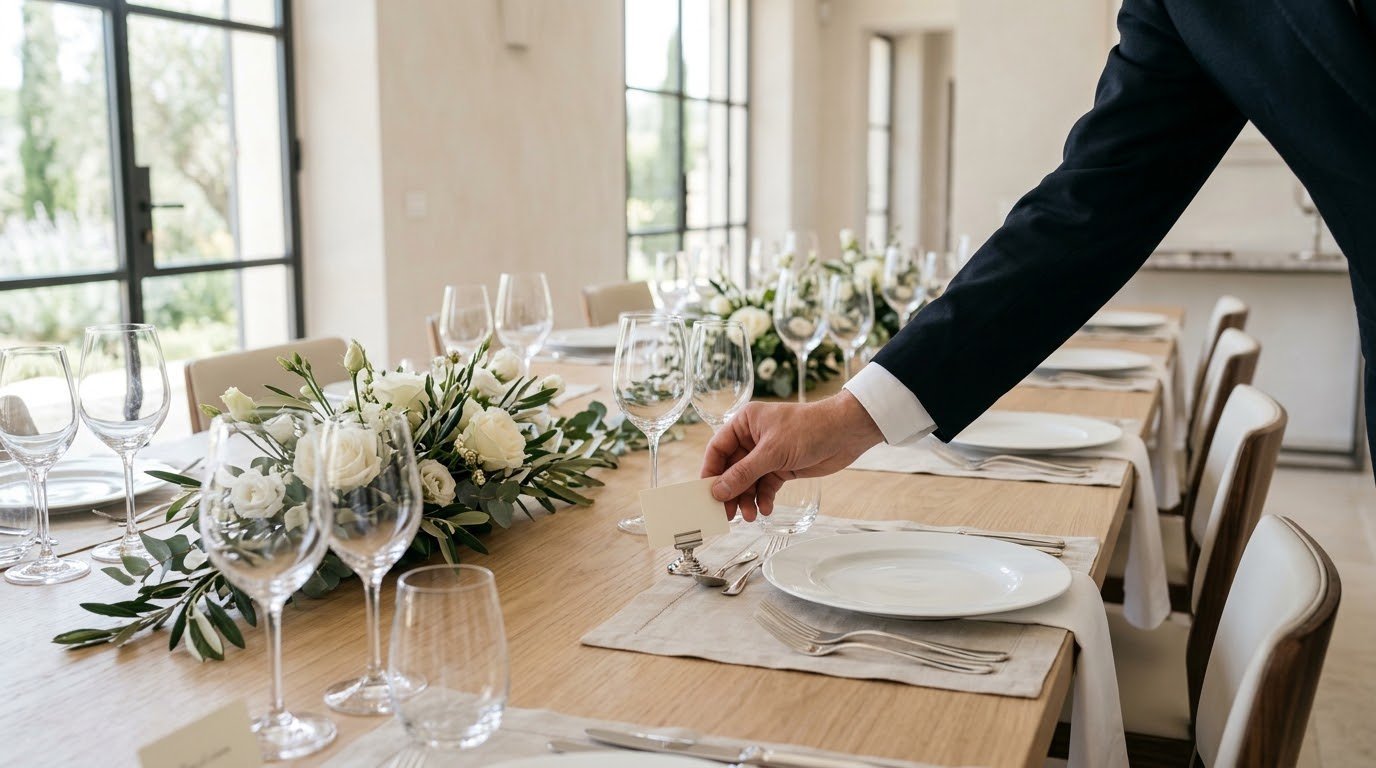
Place cards in a private house are shorter. We write the form you would use when speaking about the guest to somebody else: “Lord Aldford”, “The Ambassador of Norway”, “Cardinal Rossi”, “Signora Bianchi”. Spouses get their own card with their own name. No “Excellency” on a place card, ever; it reads like a menu that announces the wine is expensive. Where each card goes on the table is in how to set a formal table.
For introductions there is one old rule. The junior person is presented to the senior one, the title is said once, and then you give the two of them a thread to pull. “Your Excellency, may I introduce Signora Bianchi? She’s the one who restored the frescoes in our library.” That second bit matters as much as the name. It hands two strangers something to talk about.
Write the spoken form, the pronunciation and the spouse’s name on the guest sheet the staff receive. Staff keep the formal form for the whole visit, even after the guest says “Oh, call me Charles.” The guest is being kind; the staff are at work.
When the guides disagree
They do, more often than their tone suggests: on dukes, on bishops, on “Eccellenza”, on women in office. Where the books disagree, we follow the guest’s office. Where the office has no view, we use the more formal form on paper and the warmer one in conversation.
We have put the forms we use most onto our one-page forms of address card, free to download, which fits in the drawer of the hall table. For the whole system, with seating, precedence, invitations and the guest sheet we hand to the team, there is The Protocol Book. If a visit is coming and you would like the team briefed by someone who has done it before, that is part of our household consulting. Forms of address are only the first minute of a visit; the rest is in receiving a VIP guest at home, and once everyone is seated, the galateo rules guests notice take over.
Questions
How do you address an ambassador?
Say "Your Excellency" once, at the greeting, then move on to "Ambassador", "Sir" or "Ma'am", or the name. A formal letter opens "Your Excellency"; a social note can open "Dear Ambassador". A British ambassador is "Excellency" only in the country of the posting, not at home.
How do you address a duke?
Socially, "Duke" or "Duchess"; "Your Grace" is the formal form, the one the staff use. On the envelope he is "The Duke of [place]". American guides tend to give "Your Grace" for everyone.
What goes on a place card?
The form you would use when speaking about the guest to someone else: "Lord Aldford", "The Ambassador of Norway", "Cardinal Rossi", "Signora Bianchi". Spouses get their own card with their own name.
We write the Journal from our own work in private houses in Italy and Switzerland. Every house has its own rules: take what fits yours, and ask us about the rest.
Sources
- The Royal Household, Greeting a member of the Royal Family
- The Royal Household, Contact: writing to The King
- Debrett’s, Forms of address: diplomatic ranks and the diplomatic service
- Debrett’s, The trouble with titles
- Debrett’s, Addressing invitations
- Robert Hickey, Honor & Respect: how to address a duke or duchess
- Ministero degli Affari Esteri, Cerimoniale Diplomatico della Repubblica, Lista diplomatica (14 August 2026)
- Il Post, “Sua Amplissima Eccellenza Imperiale” (15 February 2016)
- Costituzione della Repubblica Italiana, transitional and final provision XIV
- Presidenza del Consiglio dei Ministri, rules on ceremonial and precedence (DPCM 14 April 2006 and 16 April 2008, coordinated text)
- Swiss Armed Forces, Leitfaden Militärprotokoll: Anrede von Persönlichkeiten (1 April 2021)
- Federal Department of Foreign Affairs, Protocol Regulations of the Swiss Confederation (2026)
- Secretariat of State, Instruction on the dress, titles and coats of arms of cardinals, bishops and lesser prelates (31 March 1969), English edition