
Wine is remarkably forgiving about where it lives, right up to the moment it isn’t. A case of Barolo will sit happily for twenty years under a villa in Piedmont, in a stone room nobody has ever thought to heat, and the same case can be quietly cooked in eighteen months in a lovely glass-fronted cabinet by the kitchen, opposite the oven. When families ask us about wine cellar temperature and humidity, they usually want one number. There is one, more or less, but it’s the second-most important thing. The first is that whatever the number is, it stays put.
The number everyone quotes, and why it’s not the point
Around 13°C, or 55°F if you think in Fahrenheit, is the figure you’ll find almost everywhere, from Jancis Robinson to Wine Spectator’s Dr. Vinny, and Sebastian Riley-Smith, answering a reader’s question in Decanter, puts the right range at 12 to 13°C. It’s a lovely number. It’s roughly what a deep cellar under an old house settles at on its own, which is presumably how it became the standard. But Robinson is quite clear that a steady temperature probably matters more than hitting 13 exactly, and Dr. Vinny calls a constant temperature the single most important element. Honestly, we’d take a cellar that sulks along at 15°C all year over one that lurches from 10 in February to 18 in August.
The trouble with swings is mechanical, more or less. Warm a bottle up and the wine swells a fraction and leans on its cork; cool it down and the cork shrinks back. Do that a few hundred times and the cork, poor thing, starts letting air sneak past. Air plus time is oxidation, the flat, nutty, browning sort of tired that nobody ordered. Warmth on its own speeds up the ageing too, so a cellar running warm is effectively fast-forwarding its wines. At the extremes it gets ugly: Robinson warns that temperatures heading towards 27°C risk boiling off the subtler flavours and stretching the seal, and that below about −4°C a bottle can freeze, which is a real risk in an unheated outbuilding in the mountains.
Wine cellar humidity, or keeping the cork happy
Humidity gets forgotten, mostly because you can’t feel it the way you feel the cold. The cork needs to stay slightly moist so it keeps its seal, which is why corked bottles lie on their sides, but the air around them matters as well. Riley-Smith recommends 65 to 70% relative humidity for fine wine, Robinson suggests something nearer 75% at cellar temperature, and in between those you’re in good company. Too dry, over the years, and the corks dry out and shrink. Too damp, and the wine itself is fine but the labels start to lift, stain or grow mould, which matters a great deal when you sell a bottle or insure one, because a label is half of its provenance.
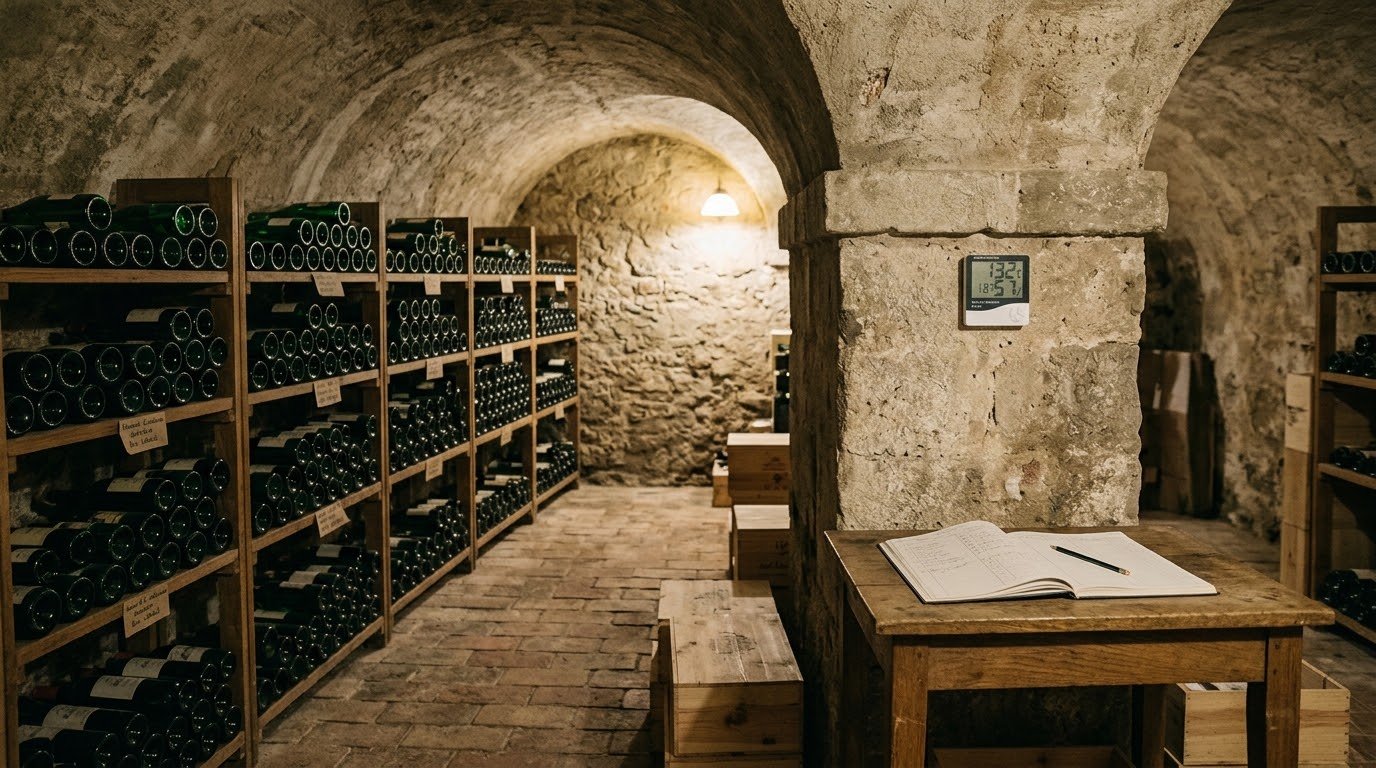
Plenty of old Italian cellars sit naturally in that range, cool and slightly damp, and need very little help beyond the odd check that damp hasn’t tipped into mould. Chalets tend to go the other way. Run the heating from November to April and the air turns bone dry, and the storeroom next to the ski boots becomes, as far as a cork’s concerned, a small desert. For dry air, a tray of water or a little humidifier; for damp, a dehumidifier and a bit of a draught. Neither is rocket science. And Dr. Vinny’s reassurance is worth repeating: for most cellars in most climates, humidity is a secondary worry next to temperature.
Light, vibration and smells
The other enemies are less dramatic but just as real. Light, especially daylight and bright fluorescent tubes, can damage wine, and sparkling wines and anything in a clear bottle (a lot of rosé, for a start) suffer first; a cellar should be dark except when somebody is actually in it. Vibration’s another, the hum of a lift shaft or a pool pump or the spin cycle next door, and wine doesn’t love it. Smell is the sneaky one. Robinson steers people away from the garage if there’s any whiff of petrol or oil, and we’d add the room where someone keeps the paint tins and the heating oil. Neutral air, then: no petrol, no white spirit, no sacks of onions waiting for the cook.
Our pet hate, though, is a cellar sharing a wall with the boiler room, simply because the architect had a gap on the basement plan and wine seemed a nice use for it. All winter that wall is warm to the touch, and the bottles stacked against it are quietly getting older faster than their neighbours three racks away.
Cellar, wine cabinet or spare room?
If there’s no proper cellar, there are three honest options. A good wine cabinet, set to a fixed temperature and left alone, does the job very well for a few hundred bottles; the cheap ones with poor insulation and a noisy compressor rather less so. A room or a deep cupboard can be insulated and fitted with a cooling unit (and a container of water for humidity, as Robinson suggests), which is how most cellars in newer houses are actually made. And for a serious collection, professional storage with a specialist merchant or warehouse is often the safest home of all, with the house keeping only what it will drink in the next year or two.
What we’d avoid is the spare bedroom, which is almost always warmer than people think, the space under the stairs next to a radiator, the top of the kitchen units (where heat collects), and any outbuilding without insulation, which will be too hot in August and may freeze in January.
How to check a wine cellar without fuss
The gadget that sorts all this out costs less than a decent bottle: a digital thermometer-hygrometer with a min/max memory. Put it in the middle of the room at bottle height (by the door, it mostly measures the door). Somebody reads it once a week and writes the figures down, then resets it. Over a year those little notes tell you everything: whether the room holds steady, whether summer pushes it up, whether the humidity sags when the heating comes on. In a seasonal house that’s closed for months, it’s the first thing to check on opening and the last thing to note on closing, alongside everything else in closing a summer house properly.
Power cuts deserve a line in the plan as well. A cellar room with thick walls will hold its temperature for a good while; a wine cabinet starts warming as soon as it stops, and it’s worth knowing who will check it if the power goes while the family is away.
The cellar book: knowing what’s in the room
A cellar runs on two things, the room and the record, and many houses have the first without the second. It needn’t be leather-bound. Each bottle or case gets an address (room, rack, row, bin), and whenever one comes in or goes out, somebody notes the date and their initials. Boring? Yes. But it’s the only way the house knows what it owns, which bottles are ready now, which were being saved for a christening, and what on earth to tell the insurer the morning a pipe bursts. Who holds the cellar key, and who may bring wine up for a dinner, belongs in the house manual for the staff; choosing what to serve and in which order is a different pleasure, part of planning a dinner party at home.
The Wine Cellar Book sets all of this out for a house in Italy or Switzerland, or for several houses at once: the room, the location codes, receiving and checking wine, insurance, power cuts and floods, with printable cellar book pages and an Excel inventory. If you’d rather have the cellar counted, coded and kept for you, that’s part of our household management. Either way, tell us about the house.
Questions
What is the ideal temperature for a wine cellar?
Around 13°C (55°F), and anywhere from about 12 to 15°C works well, as long as it stays steady. A constant temperature matters more than hitting an exact number, because swings make corks expand and contract and can let air into the bottle.
What humidity should a wine cellar have?
Roughly 65 to 75% relative humidity. Much drier, over years, and corks can dry and shrink; much damper, and the wine is fine but labels lift, stain or grow mould, which matters for resale and insurance.
Is a wine fridge as good as a cellar?
A good wine cabinet set to a fixed temperature is a sound home for a few hundred bottles. Poorly insulated, noisy models are less so. For a large or valuable collection, an insulated cellar room or professional storage is safer.
Why are wine bottles stored on their side?
So the wine keeps the cork moist and the cork keeps its seal. Bottles with screwcaps can be stored at any angle.
We write the Journal from our own work in private houses in Italy and Switzerland. Every house has its own rules: take what fits yours, and ask us about the rest.